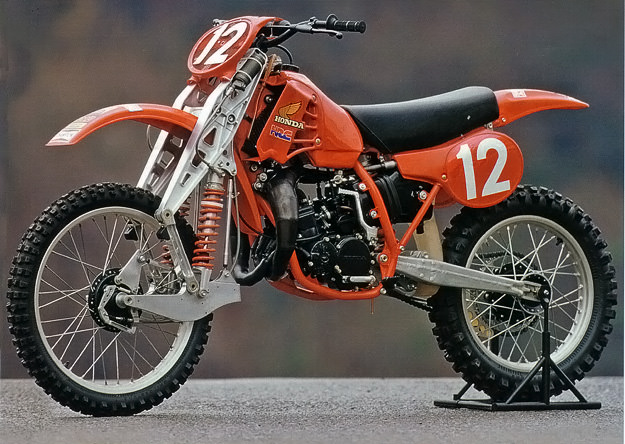
Honda RC125M

1980 Honda RC125M Twin motocross bike
By guest writer Richard Fowler of Motorsport Retro. This radical motocrosser from 1980 was the result of the Honda factory’s open chequebook—and a desperate desire to see off its rivals. Born in response to Gilera‘s twin cylinder motocross bike, the Honda RC125M Twin was nothing short of a beautifully engineered technological marvel. Producing a staggering 35 horespower at 13,000 rpm from a reed-valved and watercooled, 124.99cc motor, the red rocket brought a new meaning to the word ‘screamer’. That radical ‘Ribi’ front end was seen as a worthwhile experiment after Roger DeCoster achieved some success with the design aboard a factory Suzuki RN in 1978; when DeCoster switched teams, he introduced Valentino Ribi to Honda and they bought the rights, which they own to this day. The benefit of the system was a flex- and friction-free operation, coupled to a highly adjustable and variable rate of progression—similar in effect to modern-day rising rate rear suspension systems. The downside was the staggering cost of the 19 separate components, the difficulty in setting it up, the weight, and the fact that visually, it resembles a techno praying mantis. The bike debuted at Suzuka in 1980 with Kenji Sato aboard, and had further outings in 1981 before the FIM stepped in and banned twin-cylinder bikes from international competition. A single cylinder version of this bike—once more with a Ribi front end—won the 1981 All Japan 125cc Motocross Championship in the hands of Yasuo Tofukuji.

PS: Get the latest from Bike EXIF via twitter and our Facebook page.


11 Comments

  1. mitch said:
    Monday 28th December, 2009 at 4:51 pm | Permalink

    What an incredible looking bike

  2. Anders said:
    Monday 28th December, 2009 at 5:00 pm | Permalink

    what a hidden gem!

  3. Kozzy said:
    Monday 28th December, 2009 at 5:14 pm | Permalink

    Looks brutal.

  4. Giannis said:
    Monday 28th December, 2009 at 6:44 pm | Permalink

    They made a 250 too…

  5. rich said:
    Monday 28th December, 2009 at 6:49 pm | Permalink

    Giannis, yes that right they also made a 250cc bike, which was also a twin cylinder machine.

  6. JS said:
    Monday 28th December, 2009 at 7:43 pm | Permalink

    Interesting front end, but how is this really different from a Greeves front end or an Earles Fork? They all seem to have a pivoting swing arm attached to the axle.

  7. JU said:
    Monday 28th December, 2009 at 7:53 pm | Permalink

    cool earles!

  8. T said:
    Monday 28th December, 2009 at 11:16 pm | Permalink

    ooo. old school motocross. i hated the rich kids that had those bikes when i was 11. now i want one. i bet i’ve got scarier tattoos then they have. scars, too. do. wakka. doo.

  9. Johnny Sport said:
    Tuesday 29th December, 2009 at 12:27 am | Permalink

    What a beast! But what advantage is a twin with such small capacity?

  10. Tuesday 29th December, 2009 at 5:11 pm | Permalink

    JS; While I’m not a suspension expert, I noticed the text mentioned “flex- and friction-free operation, coupled to a highly adjustable and variable rate of progression”. The Earles forks on my MZ and my mate’s BMW are indeed flex- and friction-free, but not adjustable for anything but trail. My guess is that a) Honda would have used the less complex Earles fork if the gain from this monstrosity wasn’t considered worth it, and b) that they gave it up because the buying public preferred the looks and the (most likely) lower price of a conventional front end.

  11. JS said:
    Wednesday 30th December, 2009 at 7:54 am | Permalink

    Kim-

    Well, nothing is really ever “Friction Free” of course, but I get your drift. They likely mean free of sliding friction as opposed to turning friction.

    RE the adjustability: Actually, a BMW Earles for is adjustable. It has two settings for the rake and trail. One is for sidecar use and one for solo. Is that HIGHLY adjustable? NO, but conceivably you could make it so.

    Rate of progression I suppose would have more to do with the spring and cartridge than the actual hardware.

    I suspect that you are correct that it is the cost more than anything which kept the front end out of the hands of consumers. if you compare this to a BMW Earles, or any Earles fork of the 60′s era for that matter, you can see that this is a very complex aluminum casting, presumably to make it light. The 1960′s Earles were all welded up steel, which is much cheaper, of course.

Post a Comment

Your email is never shared. Please stay on topic and play nice with your words according to our Comments Policy. If you include a link in your comment, it may take a little while to appear. Enter your personal information below: required fields are marked*.

*
*

Subscribe without commenting