Monday 15th February, 2010

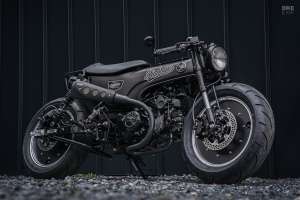
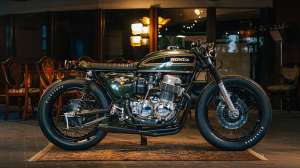
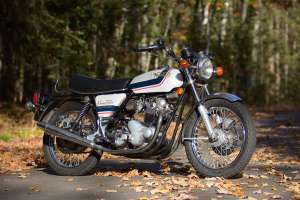
Honda’s CB450 never quite met its sales expectations, despite being one of the few 1960s motorcycles to hit the magic 100bhp/liter mark. Honda claimed it was a 450 with the power of a 650—and yes, it was a technological step forward from the British twins of the time. Buyers got greater reliability, an electric starter and more advanced engineering inside the DOHC parallel twin, which included unusual torsion valve springs. This elegant CB450 is a 1969 model that was rebuilt as a cafe racer by Shaun Stewart of Slingshot Cycles, [oops, the website has now crashed] a Virginia-based outfit that specializes in manufacturing brake hoses for classic motorcycles. The rear seat is actually part of a Yamaha XS650 fuel tank, while the front end is a hybrid mix of CB550/CB750F components strengthened by a homemade fork brace. The stainless steel exhaust system is also homemade, and the headlight bucket has a built in tachometer. Shaun likes to customize a couple of bikes a year as a sideline, and he’s done a great job with his cafe racer: it’s the perfect machine for blasting around the Appalachian mountains and Shenandoah Valley.
PS: Get the latest from Bike EXIF via twitter and our Facebook page.
Sunday 14th February, 2010

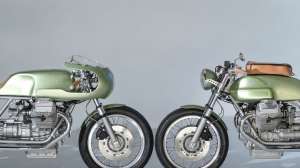
If you have a 1993-2005 model Ducati Monster, how do you make it look a little different to all the others? The Monster, despite its sales success, is a difficult bike to customize. The trellis frame dominates the bike’s appearance, so most custom Monsters are radical redesigns—such as the JvB Moto Flat Red. Bologna-based Roberto Totti, however, has come up with an alternative solution called ‘Recycle’. There are two flavors—café racer and scrambler—and the modified parts are interchangeable. It’s a modular approach centered on fibreglass tank covers, a new single-silencer exhaust system with three configurations (high, low and intermediate), and various seat/base setups according to the look you want. Spoked as opposed to the usual light alloy wheels are also available. It makes it relatively simple to create a different look for Ducati’s breakthrough machine, and one that extends beyond the usual Termignoni muffler upgrade. Why hasn’t anyone thought of this before?
Friday 12th February, 2010

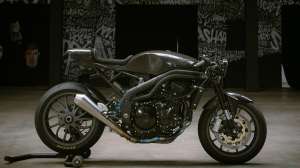
Underground Bobbers is a California-based shop that grew out out of a gel-coat and carbon fiber business. Today, they’ve turned their attention to customizing old British iron, but not in the usual way—these bikes invariably have metal parts replaced with carbon fiber or Kevlar. This bike, known as ‘The 72’, is a great example. It arrived in the workshop as a tired, Army Green-painted Bonneville: over three months, Reza Gohary and Farzin Yassiny transformed it into a motorcycle with attitude. The battery box is crafted from aircraft-quality mono-directional carbon fiber; the gas tank is made of a single sheet, hand laid and vacuum formed. Other carbon fiber parts include the headlight, fender and fin, seat unit, shock covers and even the sleeving on the exhaust pipes. Underground Bobbers describe the bike as “tough and mean, without an ounce of graciousness to it”, a look that’s helped by the dual-sport Avon Distanzia tires. If you like this style, the bike is on eBay right now. [Thanks to Tim Besser.]
Nikon D2Xs | 1/125s | f/16 | ISO 200 | Focal length 55mm
Thursday 11th February, 2010

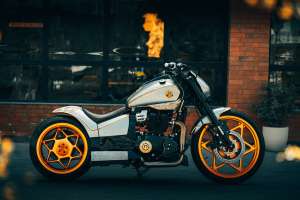
We stumbled across this one on Roland Sands’ blog, and had to show it straight away—even if it means running two Harley bikes in a row. (Let us know in the comments if that’s too much.) ‘Get Rhythm‘ is based on a lowered 2004 FXSTB Night Train, which was an 88-ci Softail derivative aimed at the European market. The bike was built by UK dealer Shaw Harley-Davidson and includes a whole raft of Performance Machine parts, including wheels, mid-mount controls, master cylinders and switchgear. Get Rhythm is also rockin’ a PM Phatail—a bolt-on kit that allows an 18×8.5 wheel to rest comfortably in a stock H-D Softail frame. It probably doesn’t do much for the handling, but it looks good. The vintage-style seat and gas tank are from RSD, and the paint is from Image Design. I’m not sure about you, but I think the overall effect is terrific—and yet another direction that Harley management could look at to broaden the appeal of their range. [Incidentally, if you're a fan of the Man In Black, head over to the sublime Selvedge Yard for a photo essay on Johnny Cash at Folsom Prison.]
PS: Get the latest from Bike EXIF via twitter and our Facebook page.
Wednesday 10th February, 2010

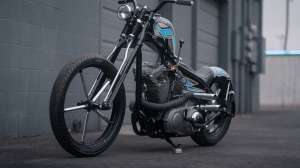
One of the coolest bikes in the latest issue of Greasy Kulture magazine belongs to Chris ‘Simo’ Simmonds, a certified old bike nut who lives on the south coast of the UK. As well as this 1931 Harley-Davidson VL, he owns three Indians and a brace of Triumphs. Simo found the 1200 cc VL on eBay UK, and describes it as a “rolling, held together basket case”. But it had the essentials he was looking for: an original frame, a springer fork and an engine. He didn’t want to do a restoration, so he created his own vision of a bob-job, inspired by the American cut-downs and racers of the 30s and 40s. VL Heaven provided many of the missing parts; the headlight, fuel tank and footboards are reproductions. The original fenders and taillight were taken off and put safely to one side, and a ribbed rear fender from Baron’s Speed Shop was fitted to the back instead. The engine was supposedly rebuilt, but wouldn’t run right, and Simo eventually discovered it had mismatched heads—one low and one high compression. After a top-end rebuild by RTO Engineering, Simo reckons “It’ll do 70-80mph. It’s like a tractor, but so much fun!” [Order your copy of Greasy Kulture for more of this goodness.]
Canon EOS Digital Rebel | 1/500s | f/13 | ISO 1600 | Focal length 40mm
Tuesday 9th February, 2010

Norwegians have always had the travel bug. After all, they discovered Iceland in the 9th century and, as Vikings, spent a good amount of time raiding the British Isles. Upholding this fine tradition over a thousand years later are Tormod Amlien and Klaus Ulvestad: as we speak, they’re circumnavigating the globe on two ancient Danish Nimbus motorcycles. The bikes are rough-and-ready, well-used motorcycles—they’re ostensibly late 1930s models, but in reality, both are a motley assortment of parts from multiple sources, including the military and police. They’ve been fitted with sidecars and extensively overhauled, because Tormod and Klaus don’t have a support crew to help with motorcycle parts when the bikes invariably break down. (They left New York in the freezing cold a week ago, so hopefully they’re still in one piece.) The engines are 750 cc OHC straight fours, with exposed valves and rocker arms, and shaft drive. And although these bikes are hardtails—ouch—they’re also the world’s earliest production bikes with telescopic front ends, beating BMW by a year. The ‘King Croesus Contempt for Death Trip 2009’ is chronicled on a website and blog, complete with video diary, and the Minneapolis episode (27) is especially worth watching—with an interview and a segment that includes Erik Buell. Suddenly, my life seems much less interesting. [With thanks to Søren Grønbech, who looks after the project website, and whose own stunning Nimbus we’ll be featuring in the near future.]
Nikon D700 | f/18 | ISO 500 | Focal length 24mm
PS: Get the latest from Bike EXIF via twitter and our Facebook page.
Monday 8th February, 2010

Belarus is a European country—pop. 9.85m—that most folks would have difficulty finding on a map. (It’s on the western border of Russia.) It’s not a place you’d expect to find a top-flight custom motorcycle designer, but a Belarusian machine won the Best Streetfighter trophy at the last Custombike show in Germany. And that same bike has just won the Best International Builder award at the Verona expo in Italy. The bike is called DUster and it’s from YSC, a name to look out for in the future. Owner Yuri Shif has created a very original look—baroque is the word that springs to my mind—using a Ducati Monster engine and transmission. The frame, bodywork and swingarm suspension are Shif’s own creations and the front fork is a modified Showa item. Custom perimeter brakes give the wheels a clean profile. It’s to Shif’s huge credit that he has achieved success in a country without a mainstream custom culture, and without a huge network of parts designers and suppliers. DUster will no doubt be heading Stateside soon: what kind of reception do you think the radical styling will get? [Check the Bike EXIF Facebook page for more just-released studio shots of DUster.]
Canon EOS-1Ds Mark III | 0.3s | f/11 | ISO 1250 | Focal length 100mm
Sunday 7th February, 2010

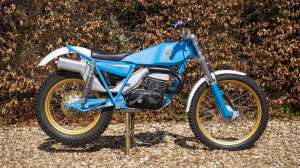
This replica of a works Honda motocross bike is causing a ripple in vintage motocross circles. In the mid-70s, the poster boy for motocross was Marty Smith, and he rode an RC125 Elsinore. Although it looked similar to the Elsinore you could buy at your local dealer, it was actually a seriously tricked-out bike [PDF]. And now the Vintage Factory has created this replica, complete with a multitude of works parts. The company specializes in first class restorations, building Honda MR50, XR75, and CR125 and 250 Elsinores—including ‘themed’ bikes such as FMF, DG and Mugen racers from the 70s. If you’re a vintage motocross fan, you’ll find their site addictive. And while we’re on the subject, another vintage MX site worth visiting is Terry Good’s MX Works Bike, which has well-shot photo galleries of 60s and 70s machinery from the major Japanese makers, plus rare readers’ rides from the likes of Lito, Combi-Triumph, Monark, Mugen, Noguchi and Puch. Make sure you have an hour or two to spare before you start digging. [Via Motorsport Retro.]
Nikon D40 | 1/160s | f/6.3 | ISO 200 | Focal length 26mm
PS: Get the latest from Bike EXIF via twitter and our Facebook page.
Saturday 6th February, 2010

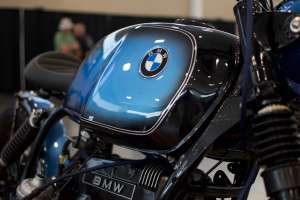
I’d be a very happy man if this was the sight that greeted me when I opened my garage door on a Saturday morning. Unfortunately, this is not my workshop; it’s that of Ritmo Sereno in Tokyo, a treasure-trove of exquisite vintage machinery. Right now they’re working on this R69S, which is being customized to a client’s specification. The Munich-built R69S had a long production run—throughout most of the 1960s—and was powered by a 594 cc boxer twin putting out 42 bhp. It was not the fastest machine you could buy, but the engineering was state-of-the-art. The motorcycle magazines were enamoured: in 1962, Cycle World said, “Whatever the BMW’s merits in a contest of speed, it is still the smoothest, best finished, quietest and cleanest motorcycle it has ever been our pleasure to ride. To be honest, we think that anyone who would worry much over its performance-potential is a bit of a booby. The R69S is fast enough to handle any encounter, and it has attributes that are, in touring, infinitely more valuable than mere speed.” Ritmo hasn’t revealed the mechanical modifications yet, but the suspension, bars and exhaust system are new. The bike has also been fitted with revised bodywork including a new fairing, fenders, seat and rear cowl. For more pictures of the original—including some with a sidecar fitted, as was common—check out BMBike’s R69S page.