

If you enjoy getting your arms yanked out of their sockets, the BMW S 1000 RR is a dream machine. With 199 stout German horses under the tank, it’s one of the fastest road-going bikes in the world. It’s also one of the easiest superbikes to ride—making it the weapon of choice for trainers like the California Superbike School.
So how do you improve on this perfektion? BMW Motorrad France decided to find out. They’ve given an S 1000 RR to PRAËM, the Paris-based custom house that first wowed us with its futuristic Honda RC51.

PRAËM is run by brothers Sylvain and Florent Berneron, both in their mid-20s. They come from a racing family, and have always been star-struck by the track machines of the 1970s and 1980s.
They’ve decided to build a different kind of custom—one still based on personal interpretation, but without screwing up the base bike.

“This is about performance and style, not just style,” says Sylvain. This BMW still scythes through bends with authority, but looks like no other Double-R.
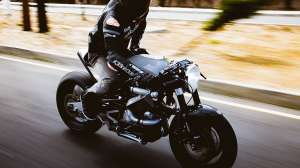
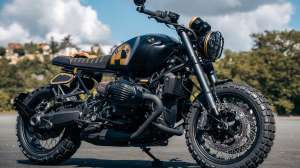
‘Optimus PRAËM’ is clothed in sleek new bodywork inspired by the endurance racers of the 1980s. The paint is a homage to the first of the famous BMW Art Cars, the Alexander Calder BMW 3.0 CSL that raced in the 1975 24 Hours of Le Mans. And gives a hint at how the RR should be ridden…

The three-quarter fairing is especially elegant, and worlds away from sharp-edged, modern design trends. It’s based on a Suzuka 8-hour bike, with one headlight on the right-hand side, and modified to fit the S 1000 RR—with a new ram air inlet system at the front.
You can find other classic endurance styling cues in the tail section—similar in style to iconic machines like the Suzuki XR69. (There’s a custom subframe and battery carrier underneath.)

The engine covers are also custom, and designed to replicate the casings from the seventies.
The aluminum fuel tank is a heavily modified stock tank. It’s around 50mm (two inches) longer than standard, and with a new upper section that now houses a Stäubli endurance-style quick-fill fuel cap system.

The carbon wheels are reminiscent of classic Dymag alloys. Manufactured by Rotobox, they knock a healthy five kilos (11 lbs.) off the unsprung weight. Further reductions come from Sicom carbon-ceramic brake discs, and the brakes and coolant hoses all feature Stäubli quick release connectors.
So what hasn’t changed? The suspension and swingarm are both stock, to retain the electronic adjustment.

The engine internals are also unchanged, since there is more than enough power for both road and track use.
But there are titanium exhaust downpipes by Akrapovič—terminating with a one-off muffler—and the radiator has been swapped for an endurance-spec item.

The PRAËM RR tips the scales at 20 kilos (44 lbs.) lighter than the standard bike, and the Berneron brothers have wasted no time enjoying the improved power-to-weight ratio on the track.
“We rode it at Circuit Paul Ricard in the south of France a few days ago,” says Sylvain, "and we have three more days of riding planned. We need to ride it 1,000 km before we can do a full race.”

A race? “We are trying to connect racing and customizing,” he explains. “Creating a race bike is a form of customizing—in the old days, a lot of race bikes were prototypes based on road bikes.
“Customizing is the same: you have a vision, and you make it happen to see how it works.”

The PRAËM S 1000 RR has now returned to BMW, and they probably won’t be letting go of it any time soon.
Frédéric Stik, BMW’s French general manager, is obviously pleased with the result: “Sylvain and Florent have managed to create what would have been the perfect race bike in the eighties. It’s a new and fresh vision of what can be done in the custom motorcycle field.”

If you want PRAËM to modify an S 1000 RR for you, they have all the facilities in-house apart from the paint.
“We can replicate this bike, as long as the donor machine comes to our workshop. The S 1000 RR is too complicated to be worked on by just anybody.”

We have one more burning question: is the PRAËM BMW road legal? “It depends on the country,” says Sylvain. “In France, as long as you don’t modify the ‘main construction’—the ground clearance, wheelbase, steering angle and so on—you can ride it. Maybe not in Germany though, as it is at the moment.”

If you want to see the bike in the metal, there will be plenty of opportunity in France this summer. The bike will be on display at the MotoGP, at Wheels and Waves in Biarritz, and at the Moto Legende show. It’ll also be one of the stars at the BMW Motorrad Days at Garmisch-Partenkirchen.
There is also a good chance, if the Berneron brothers get their way, you might see it being ridden in anger at a track day—just as it should be.
Facebook | Instagram
Comments