

The Harley-Davidson Sportster is often called ‘America’s Horse,’ a blue-collar hero that has remained in continuous production since 1957. But before the refined, rubber-mounted Evolution engines of the modern era, there was the Ironhead. Produced from 1957 to 1985, the Ironhead Sportster earned its name from its heavy cast-iron cylinder heads, a characteristic that made it run hot, shake violently, and sound like a mechanical thunderstorm.
In its day, the Ironhead was the superbike of the Harley lineup, designed to fend off the lightweight British twins from Triumph and Norton. It was raw, minimalist, and inherently aggressive. Today, while the Evo Sportster is the go-to for bolt-on builders, the Ironhead remains the choice for the purist and the provocateur. It is a temperamental engine that requires a specialized mechanical vernacular, but when dialed in, it offers a connection to the road that few modern machines can match.
At Bike EXIF, we have a long-standing love affair with this overhead-valve dinosaur. Here are seven of our favorite Harley-Davidson Ironhead Customs that prove that with enough grit and ingenuity, these old dogs can still teach the world a few new tricks.

The 'Iron Maiden' by Motonaut
Munich-based Michael Middeldorff, operating under the name Motonaut, created this stunning tribute to the legendary XR750 flat tracker. Dubbed the 'Iron Maiden,' this build is a ‘bitsa’ in the truest sense, blending a 1966 XLCH motor with a modified 1979 XLS Roadster frame. Michael’s goal was to capture the lean, mean silhouette of a factory racer while ensuring the bike could actually survive the rigors of the street.

The technical specs read like a multinational summit: Ceriani GP replica forks up front, a 2018 Street 750 brake caliper, and a master cylinder sourced from a KTM quad. The rear is equally eclectic, featuring a Ducati 916 master cylinder and a 1990s KTM LC4 Brembo caliper. The 59-year-old engine was rebuilt for reliability over outright speed, featuring electronic ignition and ceramic-coated covers for a modern, durable finish.
Visually, the bike is a triumph of orange-and-black nostalgia. The fiberglass tank and tail section sit perfectly on the modified frame, while the minimalist cockpit, featuring Motogadget electronics, keeps the focus on the mechanical heart. It’s a bike that looks like it just rolled out of a 1970s paddock, yet functions with the precision of modern German engineering. [MORE]

‘Double Trouble’ by Hot Chop Speed Shop
In Kyoto, Japan, Kentaro Nakano decided that one V-twin simply wasn’t enough. Double Trouble is an exercise in symmetrical lunacy, featuring two Sportster XLCH engines linked in tandem. While twin-engine Harleys were a staple of 1970s American drag racing (think Bonnie Truett and Elmer Trett), Nakano-san is the first to successfully bring this level of engineering audacity to the Japanese custom scene.
The front engine is a 1969 unit, while the rear is a slightly older variant. Both were meticulously blueprinted and timed to create a unique exhaust cadence; at low RPMs, it’s a classic Harley lope, but at high speed, it screams like a Japanese multi-cylinder race bike. To handle the massive torque load that would surely shred a stock 1960s transmission, Nakano fitted a heavy-duty four-speed gearbox from a 1980s Big Twin.

The frame is a complete custom fabrication, rolling on 18-inch aluminum H-type rims shod with M&H drag slicks. The bodywork is deliberately spare, with a simple cylindrical fuel tank and a rear cowl that doubles as an oil reservoir. With a supercharger waiting in the wings, this is a machine built for the singular purpose of chasing land speed records at the Bonneville Salt Flats. [MORE]

The XLCR Tracker by HardNine Choppers
Danny Schneider of Switzerland’s HardNine Choppers is a man who knows how to work under pressure. While battling a personal health crisis, Danny channeled his energy into this 1979 XLCR, a model that was famously a sales flop for Harley in the late 70s but has since become a cult icon. Danny convinced his client to let him ditch the cafe racer bodywork in favor of a high-performance flat tracker aesthetic.

The 997cc Ironhead was bored out to a massive 1,340cc, with KB Performance pistons, giving the bike a punch that matches its aggressive looks. The frame was overhauled to accept an FXR front end, upgraded with Öhlins cartridges, while Bitubo shocks handle the rear. The exhaust is a work of art, featuring nickel-plated pipes that exit high under the hand-hammered aluminum tail section.
The color scheme, a fresh, airy light blue and white, was inspired by a random mini-bike Danny spotted on the streets of Bern. It provides a striking contrast to the exposed battery and racing-grade Beringer brakes. This build is a testament to the emotional power of customization; it is a "diamond made under pressure" that rescued an unloved classic and turned it into a world-class tracker. [MORE]

The 'Hide Motorcycle' Sportster
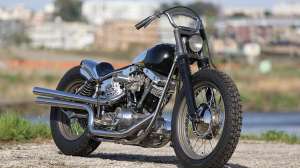
Hideya Togashi is a legend in the Japanese custom world, and this 1966 XLCH is the reason why. Unlike many show bikes that sacrifice rideability for aesthetics, Togashi-san aimed for a balance of show-off craftsmanship and road usability. The heart of the build is a refurbished, high-compression XLCH engine that remains largely stock, retaining its beautiful Linkert DC-7 carburetor.
The frame is the real star here, a scratch-built hardtail with a single downtube design, finished in elegant nickel plating. The forks were sleeved and cleaned to create a seamless, smooth front end, topped with a hand-beaten aluminum headlight nacelle. Togashi opted for a 21-inch front wheel and an 18-inch rear, creating a tall, spindly stance that feels like a cross between a vintage board tracker and a European speedway bike.

The bodywork is kept raw and honest, with a polished aluminum tank featuring subtle paint based on a 1933 Harley design. The exhaust consists of two perfectly bent, nickel-plated pipes ending in flared mufflers, proving that you don't need complex curves to make a statement. It’s proof of the less is more principle, where every weld and finish is executed with surgical precision. [MORE]

‘Alpaca’ by DP Customs
Jarrod and Justin Del Prado of Arizona-based DP Customs are famous for their clean, motorsport-inspired Sportsters, but ‘Alpaca’ is their wild child. Originally, the brothers decided to turn Justin’s personal 1979 1000cc Ironhead into a permanent shop fixture. The goal was a hot rod bike, low, long, and unapologetically fast.

The defining feature of Alpaca is the draw-through turbocharger setup. The motor was completely rebuilt with forged pistons to handle the boost, fed by a "jetted to the moon" Mikuni carburetor. The frame features a 6-inch stretch and a 4-inch drop, giving it a menacing stance that is further emphasized by the 15-inch rear wheel, which has been adapted to fit the frame.
The aesthetic is pure Arizona desert: a metal-flake tank, a red-and-white frame, and a barely-there seat. Devoid of fenders, turn signals, or a speedometer, it is a machine built for the singular joy of hauling ass in a straight line. As Jarrod notes, the turbo acts as the muffler, making the sound as wicked as the acceleration. [MORE]

The Audi-Inspired Cafe Racer by DP Customs
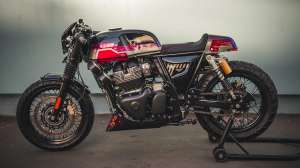
Another standout from the Del Prado brothers is this 1980 Ironhead cafe racer. While most Ironheads are cluttered with external components, DP Customs aimed for open space within the frame. They utilized a classic 1970s Maico motocross tank, made of raw aluminum, to set the angular, aggressive tone for the rest of the build.
The exhaust system, dubbed the 'Quantum-port,' is a symmetrical 2-into-1 chamber designed to provide the perfect amount of backpressure while screaming at high RPMs. The livery was inspired by the 2011 Le Mans-winning Audi R18 TDI and features a sophisticated palette of grays and blacks. To protect the rider’s legs in the blistering Arizona heat, the pipes are wrapped in heat wrap, adding a functional, rugged edge to the sleek design.

This bike is a perfect example of how the Ironhead can be adapted to a modern, high-performance aesthetic. It sheds the chopper baggage often associated with the platform in favor of a lean, functional silhouette that looks as fast standing still as it does at full chat. [MORE]

Dylan Robb’s Carbon Fiber Special
Rounding out our list is perhaps the most technologically advanced Ironhead we’ve ever featured. Built by master craftsman Dylan Robb in his garden shed in Australia, this 1969 XLCH is an absolute featherweight. By utilizing a chromoly steel frame and a massive amount of carbon fiber, Dylan managed to get the bike's weight down to a staggering 357 lbs (162 kg), nearly 150 lbs lighter than a stock Sportster.

The engine was blueprinted, balanced, and ported, converted to a left-hand gearshift for a more intuitive riding experience. The suspension consists of heavily modified Ducati 916 forks, while the wheels are Blackstone Tek carbon fiber units equipped with Brembo brakes. It is a bitsa taken to the extreme, merging vintage American muscle with modern superbike components.
Dylan’s build challenges the traditional notion of what a Harley custom should be. It isn't about chrome or fringe; it’s about power-to-weight ratios and engineering excellence. It stands as a beacon for the future of the custom scene, proving that even a 60-year-old Ironhead can be the foundation for a high-performance masterpiece. [MORE]

Comments