


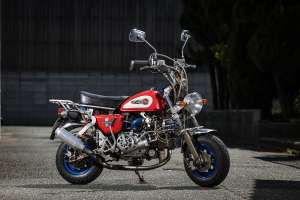
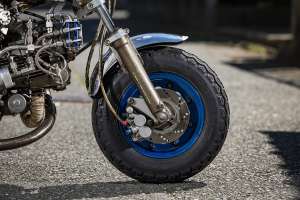
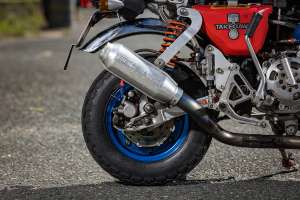
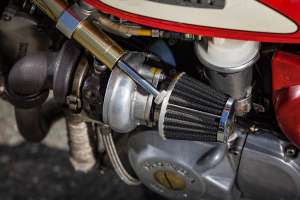
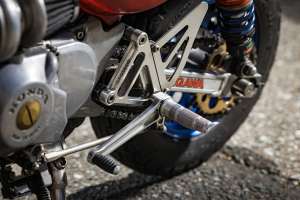
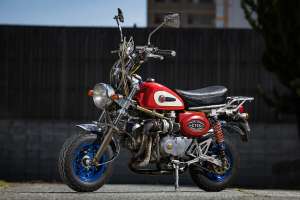

Minimoto has gone global, but the world will never catch up to Japan. The culture there is more of a sprawling ecosystem, teeming with styles, parts and models entirely foreign to us in the States, and the custom scene treats these horizontal singles with a level of reverence usually reserved for vintage superbikes. But even in a culture defined by meticulous engineering, Takao Uemura operates on a different wavelength, evidenced by this turbocharged, twin-cam 1975 Honda Monkey Z50J.

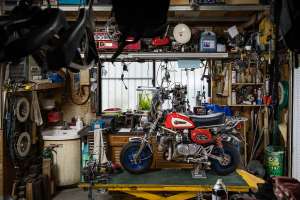
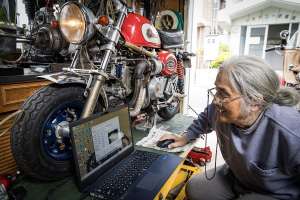
In Honda enthusiast circles, he’s known as the ‘Cub Master,’ or ‘Cub Doctor,’ and he’s devoted a lifetime to repairing and modifying minis and sharing his passion with others. His home workshop in Fukuoka City has become a gathering place, where the next generation comes to glean from the man who has every Cub-derived engine committed to memory. “Cubs that run properly” is his motto, eschewing static displays, and he’s known for 12 V conversions, big bores, electric starters, four-speed gearboxes and other improvements that keep old minis on the road today.
The roots of his obsession date back to his childhood, when he discovered a forlorn Cub in a field. “That bike’s broken. Do as you like with it,” the owner said, so Uemura and his brother set about fixing the crankcase and getting the bike running again. The joys of riding around the neighborhood were cut short when the befuddled owner went against his word and reclaimed the machine. “It’s a bitter childhood memory,” Uemura recalls, but there’s no denying the experience awakened something deep inside him.

With few amusements on his island home, Uemura continued to learn from the machines around him. He repaired an outboard motor from a sunken boat just to have the previous owner take it back as well, but he remained undeterred. The satisfaction from repairing machines, and undoubtedly these bitter experiences, helped shape a passion for top-running machines that were his, and his alone.

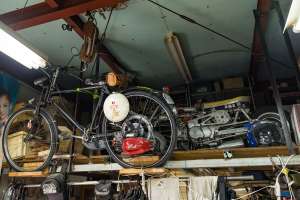
Through his adult life, Uemura worked for a ferry company linking his hometown of Tsushima and Fukuoka. He was chief engineer and maintained hydrofoils equipped with gas turbine engines before he eventually retired; motorcycles remained on the side all the while. He once affixed a Cub F engine to a folding bicycle frame and carried the engine with him on a bullet train to Tokyo, where he rode it around the city. A supercharged Monkey sits on a shelf in his garage, built for the sole purpose of drag racing. In recent years, other tastes from the world have landed in his shop, including a 1935 Harley and a Brit single from 1918, both of which were restored to running condition.

While some projects come and go, the 1975 Monkey Z50J has been around a long time. Uemura acquired it 30 years ago as a small project to tinker with in his apartment. He first converted the kick-only model to electric start. He then increased the displacement to 95 cc, but he found the acceleration underwhelming and bumped it up to 124 cc. Understandably, this caused the starter to labor, diluting the ethos behind the whole project. At that moment, Uemura decided to pour all his knowledge into the Monkey to ensure the hopped-up engine performed at the level of a factory-produced offering. The vision was a twin-cam, turbocharged package that felt cohesive and fit between the factory fuel tank and 8-inch wheels.

Sourcing the turbo was not so easy back in those days. Through his work connections, Uemura knew small turbochargers were available, but he found that big companies were reluctant to sell them to individuals. Through persistence, he eventually acquired a Mitsubishi Heavy Industries TD02MR2—the world’s smallest turbo at the time—designed for small Japanese cars.
Then came the question of how to mount the turbo on the Monkey in a functional, yet visually pleasing fashion. Space is limited (clearly), and the exercise would be invalidated if it disturbed the rest of the bike. Uemura fabricated an aluminum bracket for mounting and bent the 1.0 mm titanium pipe that carries gases from the turbo to the muffler. Given the proximity of the exhaust pipe to the up-pipe, I trust you’ll give the pipe wrap a pass—we sure do.

The cylinder head was the next hurdle, and since the Monkey’s engine already displaced 95 cc, and the turbo would enhance airflow further, the OE two-valve head would be a significant limitation. Takegawa is the best name in the business, and their four-valve, twin-cam head is basically a prerequisite for making real power with big-bore Honda—enabling stable valvetrain function above 11,500 RPM. Supporting modifications for high-revs include enhanced oiling, and you’ll note the gnarly oil cooler to help safeguard the air-cooled engine’s lifesblood.
Of course, the diminutive 14 mm Kehin carburetor originally fit to the Monkey would never support this kind of performance, and Uemura originally experimented with an FCR carb. Unable to provide boost-responsive fueling, the most technologically sound route was fuel injection, but try sourcing something like that more than a decade in the past. To start, Uemura acquired a complete injection system and base program from FC Design, a company supplying training systems to automotive engineering schools.

Through some crafty rewiring and reprogramming, the system was revised to support a boosted application with off-the-shelf injectors and a salvaged fuel pump. Further refinements resulted in a Honda Ape fuel pump mounted directly off the fuel tank, and Uemura tunes the system for performance and efficiency based on residual oxygen levels, targeting 13%. Limited to a sensible 13,000 RPM to keep the crankcase together, the little Monkey churns out around 14 hp—insane figures for an engine that put out less than 3 hp when new.
Neither photos nor text does this minimoto justice, as there are so many treasures packed into the Monkey’s pint-size footprint. The transmission has been upgraded to a six-speed using components from an AF53E Jorcub, and Uemura assembled a rotary switch that reports gear position to a digital indicator on the triple tree. The rear brake caliper comes from a Yamaha TZR50, and the clutch and braking systems are hydraulic. The suspension was upgraded with trick components from Takegawa, and a steering stabilizer helps tame the Monkey’s manners at speed. Vital parameters and performance are monitored with an array of mechanical gauges on the handlebars.

As astonishing as Uemura’s Honda Monkey is today, it’s all the more impressive when you find out it was constructed 25 years ago, and has since become a legend in Japan. Photographer Kazuo Matsumoto relays to us that the build still prompts reactions on the street from onlookers. “Isn’t this the famous turbo Monkey?” one passerby questioned.
Now aged over 70, Uemura has not slowed down and remains immersed in his love of Honda minis and other motorcycles in his home garage in Fukuoka. “I want to show that even self-taught, hand-built work can reach this level. I left school after middle school, but because I didn’t neglect studying and effort, I could create things like this. I want young people—the next generation—to know the importance of striving toward a goal and taking on challenges despite hardships.” Uemura says.

You never know where you’ll find the hidden gems and true savants of custom motorcycles, but often when you do, they’re right where you’d expect them to be. Until proven otherwise, we’ll maintain that the maestro of minimoto resides in a small shed in Fukuoka City, where he’s probably cooking up his next power play right now.
Photos by, and with our gratitude to, Kazuo Matsumoto | Steeldog Photo

Comments
美作品。(A work of art)
Time and money to burn ! Is it art?
ABSOLUTELY STUNNING and MIND-BLOWING! EXCELLENT JOB!