


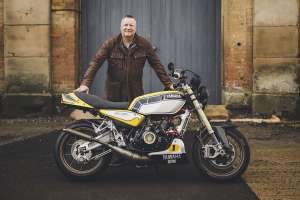
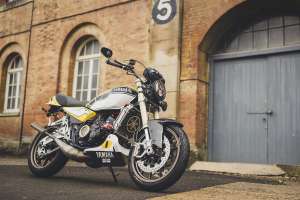
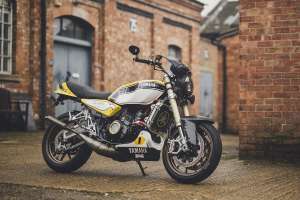
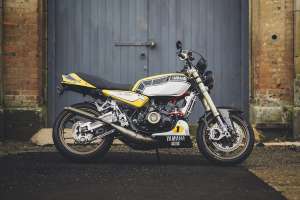
Once a teenage dream machine, this RD350LC returns as a nostalgic hybrid with sharper handling, a bigger engine and a classic Yamaha livery.

If you had a bike in the shed and a television in the mid-1970s, there’s a good chance you were dying to get your hands on a liquid-cooled Yamaha two-stroke. Yami’s new TZ liquid road racers were shaping the next generation of two-stroke performance on the tracks, but street-goers had to settle for air-cooled RD350s and 400s, which must have felt positively antiquated in comparison. But speed freaks of the era wouldn’t have to wait much longer.

Yamaha launched the RD350LC in 1980 to eager public reception, and while the production model was more of an RD with an impeller than a TZ with indicators, it still represented a quantum leap in performance if words like port and powerband were your common vernacular. Where most two-strokes had been watered-down to work well across the rev range, the 350LC’s exhaust, port timing and carburetors were optimised above 7,500 rpm, and the rear mono-shock cleaned up the handling habits of the old twin-shockers.

While the RD350LC didn’t come to the States, other markets ate up Yamaha’s new liquid and begged for more, especially in Europe. The result was predictable: a generation of riders fell in love with the LC—and a huge number of them eventually stuffed those bikes into hedges, ditches or lampposts. It’s one reason clean survivors are such a rare sight today.
Patrick Lyall remembers that era vividly. He came of age just as the LC exploded onto the scene and owned a red 250 at 17 in the ‘Bounty Bar’ color scheme. Like many riders who grew up on two-strokes, he eventually moved on to bigger four-stroke machinery. But the LC has a way of sticking in your memory; once you’ve experienced that frantic powerband, it sticks with you.

The spark reignited during the COVID lockdowns. With time on his hands, Patrick started buying tired two-stroke projects online and bringing them back to life—machines like a Montesa Enduro and a Suzuki TS125ER. Around the same time, he and a friend rode down to the Ace Cafe for the annual 2-Stroke Sunday: Blue Haze Day gathering. Among the clouds of smoke were several RD ‘hybrids’: classic LC frames upgraded with modern suspension, brakes and wheels. The concept made perfect sense. You didn’t need a complete donor bike to build something special, and newer components are easier to source—not to mention far better when it comes to braking and handling. The final push came from an article in Practical Sportsbikes Magazine covering an RD250LC hybrid built by Wayne Leach, which inspired many of Patrick's decisions during the build process.

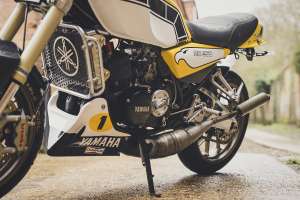
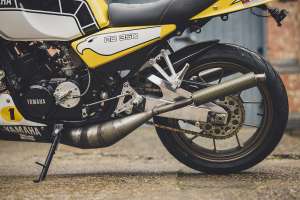
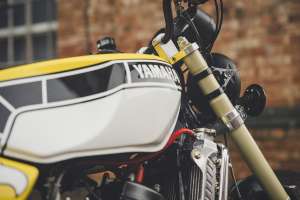
The real work started when Patrick bought an LC frame from a friend who restores these bikes. From there, he teamed up with Nigel Kimber at NK Racing to map out the chassis. Many RD hybrids run a Suzuki RGV swingarm, but Patrick felt that setup stretched the bike’s proportions too far. Instead, they opted for a swingarm from the Honda NC29, paired with forks from a Kawasaki ZX-6R. Kimber handled the machining and fabrication to make it all work, producing a chassis that keeps the LC’s compact stance while dramatically sharpening the way it rides.
Aprilia RS125 wheels finish the rolling stock, while Kimber also fabricated new rearsets and machined the necessary components to integrate everything cleanly into the original frame. The end result still looks unmistakably like an LC—but tighter, lower and far more purposeful than Yamaha ever intended in 1980.

The engine came from Italy via eBay before being rebuilt by Patrick’s friend Stephen “Rocket” Roberts. The cylinders were sent to Ron Phillips at Faron Engineering for porting, resleeving and fresh pistons, bumping capacity up to 375 cc. A pair of 32 mm Mikuni flatslide carbs sourced from the US feed the motor, while hand-built expansion chambers from Jim Lomas Exhausts provide the soundtrack. The pipes are made from mild steel—favored for performance—even if it means they require a little more care. After getting tired of polishing them constantly, Patrick eventually lacquered the pipes to keep the rust at bay.

Like many long-term builds, the project hit a few painful bumps along the way. At one point, the freshly rebuilt engine, cylinders and modified swingarm were stolen from the back of Patrick’s car—forcing him to go back to Kimber and Phillips and ask them to recreate the work. Given the waiting lists both specialists typically have, it was the kind of setback that could kill a project. Fortunately, both stepped up and helped get the build back on track.

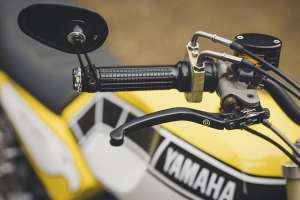
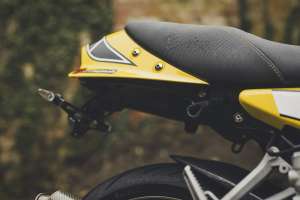
Details throughout the bike show the same level of care. The seat was shaped and stitched by Dave the Trimmer and embossed with Kenny Roberts’ signature to match the classic Yamaha race-inspired paint scheme. The electrics were handled by Andy Woolrich of Electro34, including a bespoke wiring loom. Modern digital gauges from Smiths were adapted to fit inside the original LC housing, with custom dial artwork created by Patrick’s son Matthew. Keen eyes will spot the trick hydraulic clutch setup, another piece of Kimber's handywork that brings the RD's performance into the modern era.

Final tuning happened on the dyno at RHR Motorcycles. In full race trim, the engine produced around 80 horsepower—serious output for a bike this light—but Patrick opted for a slightly softer road tune that brought the figure down to a still-lively 64 bhp while adding stronger mid-range. Even so, the motor spins to 13,000 rpm, which is awkward when your tach only goes to ten.
A race-spec TZ crankshaft and upgraded ignition are already lined up for the next stage of the build to safely support those revs. As Patrick jokes, he may end up writing the missing numbers onto the tach himself.

The finished machine is exactly what a great hybrid should be. It captures the look, attitude and nostalgia of the original RD350LC—but rides like something far sharper. To anyone who remembers the era, it’s a time machine back to the golden age of two-strokes… just with better brakes, better suspension and a lot less chance of ending up in a hedge.



Comments