



Every so often, the boundaries between the bicycle and motorcycle worlds become beautifully elastic. At Bike EXIF, we have always harbored a soft spot for builders who dare to bridge this divide. Recently, it was Tony Pereira's custom Ducati 900SS or Sean Skinner of MotoRelic channeling childhood nostalgia with his Schwinn Sting-Ray-inspired Yamaha XS650. The latest builder to blur these lines is Theo Niess, a 20-year-old transportation design student from France. Theo represents a new vanguard of design talent, possessing a rare willingness to disregard traditional motorcycle architecture in favor of something altogether more avant-garde.
The genesis of this striking prototype traces back to Theo’s internship at Canyon Bicycles. For the uninitiated, Canyon is a global juggernaut in the cycling world, engineering the high-performance bicycles ridden by titans like multi-time world champion Mathieu van der Poel. Surrounded by cutting-edge bicycle technology, Theo began to sketch out a concept that defied easy categorization. His initial idea was to explore a true hybrid between a high-end road bicycle and a motorcycle, merging structural efficiency, extreme lightness, and pure performance into a singular, cohesive object. What began as a conceptual exercise naturally evolved into a mandate to build a full-scale, functioning prototype.
Interestingly, the machine was originally conceived with an electric powertrain in mind. However, as the development process advanced, the project took a sharp, analog detour. Theo opted instead to power the prototype with a 1992 Honda CR250 engine. This unexpected mechanical pivot injected a raw, deeply emotional character into an otherwise futuristic silhouette. The 1992 CR250 powerplant is a legendary piece of motocross history, featuring a liquid-cooled, 249cc two-stroke single-cylinder engine known for its explosive mid- to top-end power delivery. With a bore and stroke of 66.4 mm by 72.0 mm, a five-speed gearbox, and Honda’s proprietary Composite Racing Valve (CRV) system, the two-stroke motor guarantees that this ultra-lightweight creation barks with absolute authority.
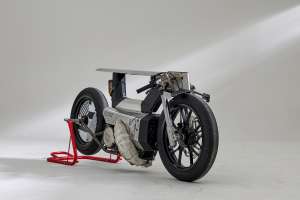
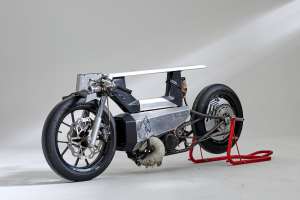
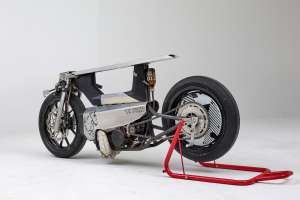
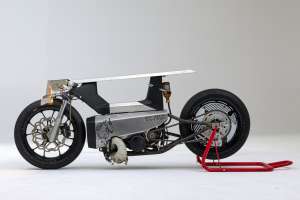
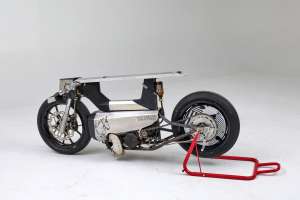
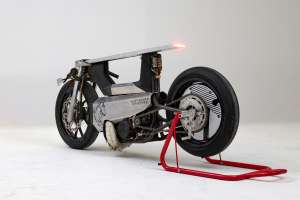
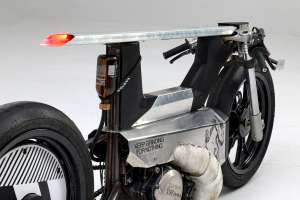
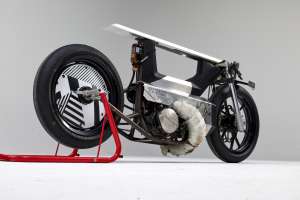
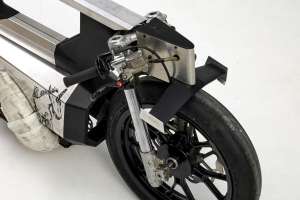
Armed with access to Canyon's state-of-the-art design, prototyping, and production facilities, Theo was limited only by the boundaries of his imagination. The resulting chassis radiates serious, dystopian Tron vibes, having been entirely cut, bent, and welded by hand by the young designer. Theo used blended manufacturing techniques, including 3D printing elements blended with structural aluminum. The architecture intentionally mimics structural forms typically found in the premium bicycle industry, prioritizing extreme aerodynamic efficiency and an optimal strength-to-weight ratio over conventional motorcycle layout rules.
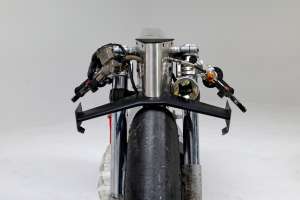
The aerodynamic obsession is most apparent at the front end of the motorcycle. The streamlined front end is adapted from a Canyon Speedmax cockpit, which was aggressively chopped and reworked to carve out a predatory silhouette. In the cycling realm, the Speedmax is Canyon’s flagship time-trial weapon, a bicycle engineered for races where drafting is illegal and cutting through the air is the only metric of success. Theo adapted this ultra-low-drag ethos to a motorized platform, pairing the sleek nose with a shortened and heavily modified set of front forks sourced from a BMW F650GS, scaled down to match the radical proportions of the machine.
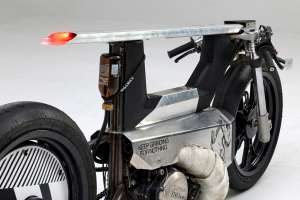
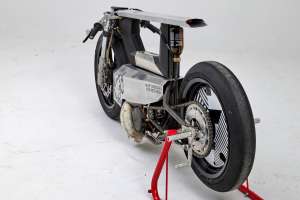
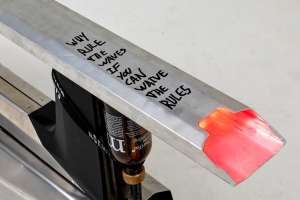
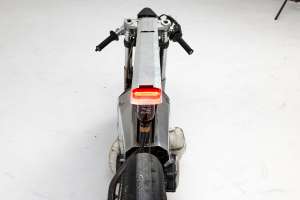
Make no mistake, this machine was never intended to be a practical daily commuter or a casual grocery-getter. Everything about its geometry screams speed. Theo fabricated custom rearsets and mounted them far back on the rear axle line near the rear wheel, forcing the rider into an extreme, ultra-low tuck reminiscent of a salt-flats landspeed racer. The bike rolls on a pair of 17-inch wheels wrapped in slick racing tires, with stopping power provided by a premium Brembo front disc brake assembly. A minimalist, custom LED taillight is nestled tightly beneath the structural rear frame, directly under what can technically be described as the seating area.
To address the obvious elephant in the room, Theo’s creation does not prioritize rider comfort. A punishingly aggressive, face-down riding position, paired with a stark, unpadded aluminum seat beam, does not invite a casual Sunday cruise. Furthermore, the machine’s fuel supply is drawn from a tiny, sub-one-liter bottle mounted directly behind the central seat tube. Yet criticizing this bike for its ergonomics is completely missing the point. Theo’s objective was to strip away every preconceived notion of what a motorcycle is supposed to look like and explore the raw margins of design possibility.
At just 20 years old, Niess has proven that the future of custom design is exceptionally bright. The young builder is quick to note that the ambitious project would not have been possible without the support of his inner circle, extending his gratitude to his grandfather, his father, Vincent, and the entire team at Canyon Bicycles who helped bring this breathtaking two-stroke anomaly to reality.



Comments