


If you spend any time scrolling through the digital archives of Mayerl Motorcycles, you will quickly notice a distinct pattern. Operating out of the quiet alpine town of Ardning, Austria, founder Wolfgang Mayerl has built a sanctuary dedicated to the golden era of American choppers. His workshop is a revolving door of vintage Shovelheads, classic Panheads, and the occasional modern, hard-ridden club-style machine. But when Wolfgang recently slid images of his latest ground-up chopper build into the Bike EXIF inbox, there was no need for a lengthy editorial debate; it was an immediate, collective, and resounding "heck yes."
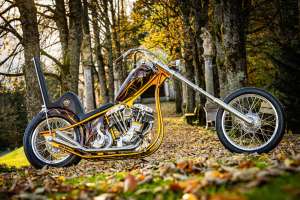
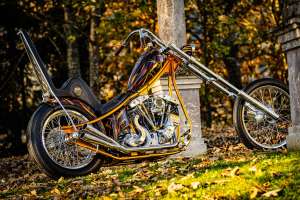
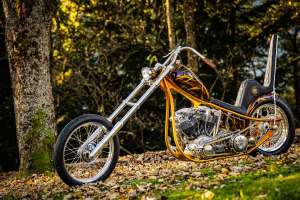
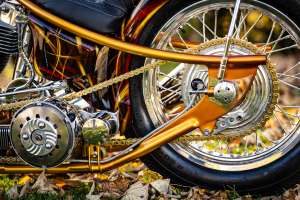
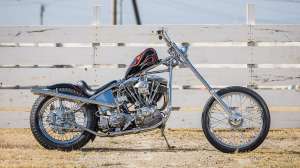
The undisputed hero of this build is its frame. To look at it is to witness a beautiful, mechanical paradox, as if a factory Harley-Davidson Panhead frame and a vintage Harley WL frame dropped acid together, had a baby, and handed the blueprints to an artist. Curved dual downtubes swoop down from the steering neck, dropping toward the tarmac in a styling cue heavily reminiscent of those early WL models. To give the chopper its mandatory stance, Wolfgang extended the neck up and out, raking the neck angle to balance an extended front end. Frankly, the only straight lines on the entire chassis belong to the central seat post and the lower frame rails, while everything else flows, bends, and sweeps with a striking, liquid-like kinetic energy.
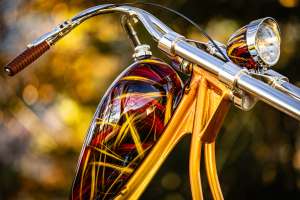
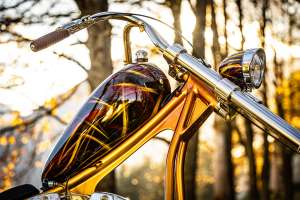
Up front, the extended telescoping fork configuration instantly channels the spirit of legendary 1970s chopper builders like Denver’s Choppers or Sugar Bear. Wolfgang took a set of traditional legs, shaved away the factory fender mounts and tabs, and treated the fork lowers to intricate, decorative accent notching. The polished custom triple trees carry a single, minimalist headlight bucket painted to match the rest of the bodywork. At the end of the elongated fork sits a skinny, 21-inch front wheel equipped with a classic mechanical drum brake for an ultra-clean hub profile, wrapped in a period-correct, three-inch-wide Shinko 270 vintage-style tire that drives home that iconic, tall-and-narrow silhouette.
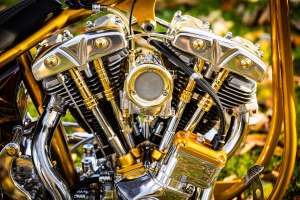
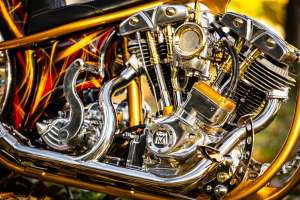
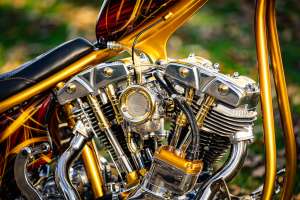
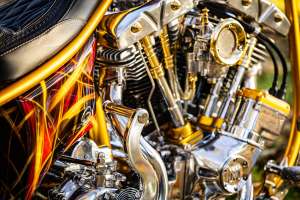
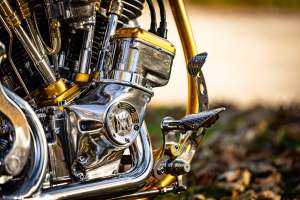
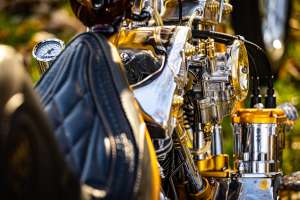
At the center of the swirling frame sits a completely revitalized Harley-Davidson Shovelhead motor. Wolfgang went through the venerable V-twin with a fine-tooth comb, optimizing it for both show-level aesthetic appeal and absolute reliability. The traditional, temperamental electrical points system was binned in favor of a self-contained, magneto ignition. Wolfgang then took the stock, square-shouldered rocker boxes and machined them, giving the top end a customized appearance. A pair of brass pushrod covers contrasts beautifully against the polished aluminum and dark iron of the cylinders.
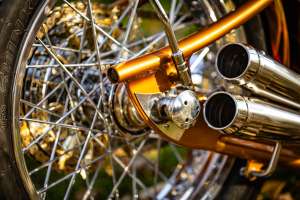
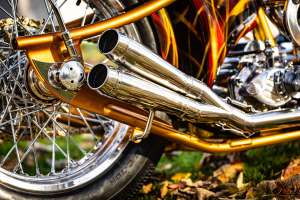
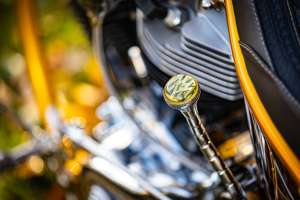
The engine breathes through a legendary S&S Super E carburetor, dressed with a brass velocity stack and a matching brass enricher knob. Heavy breathing demands a proper exit note, but while most contemporary chopper builders lean toward long, sky-high upswept pipes, Mayerl opted for a performance-driven twist. He fabricated a custom 2-into-1-into-2 exhaust system that snakes low along the engine cases and terminates right beside the rear wheel. The system ends in dual megaphone-style mufflers, injecting an unexpected hint of vintage racing swagger into the chopper’s DNA.
Power is transferred from the Shovelhead through an open primary drive. In a departure from standard chopper orthodoxy, Wolfgang used a traditional chain drive to connect the motor to the Harley-Davidson 4-speed Ratchet Top transmission. The transmission area also highlights Wolfgang's talent for hiding the ugly necessities of a functional street bike, as the 4-speed casing acts as the mounting anchor for the oil filter, keeping a notoriously cumbersome component entirely out of the motorcycle's clean visual line.
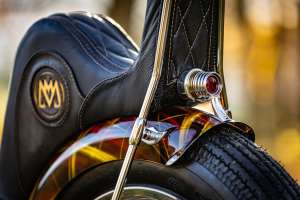
The ergonomics are lifted straight from an Easy Rider storyboard. A set of Rabbit Ear pullback handlebars keeps the cockpit incredibly stark, hosting nothing but a throttle housing and the front brake lever. Gear changes are handled with a custom hand-shift and foot-clutch linkage. A majestic, diamond-stitched King and Queen solo seat flows up the rear fender, supported by a tall, one-off sissy bar. As a nod to Milwaukee heritage, the sissy bar features an integrated eagle design, a salute to Harley-Davidson's Screamin' Eagle legacy. The sissy bar also serves as the mounting perch for a beautiful, rippled LED taillight.
A custom this radical demanded a paint job that could sing, and Wolfgang delivered. The entire swooping frame is finished in a rich, monochromatic orange-gold metallic coat. This bright foundation offers a stark, beautiful contrast to the sheet metal, where the Frisco-mounted Mustang fuel tank, rear fender, and oil tank received a complex, airbrushed finish that can only be described as crystallized. Featuring organic, prismatic shards of deep reds and electric yellows layered over a moody, pitch-black base coat, the paint shimmers in the alpine sunlight like a gemstone. Wolfgang Mayerl has managed to capture the wild, untamed lightning of the 1970s American chopper movement and bottle it with precise European execution, proving that out in the Austrian hills, the chopper spirit is not only alive, but evolving.
Comments