


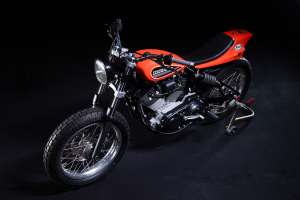
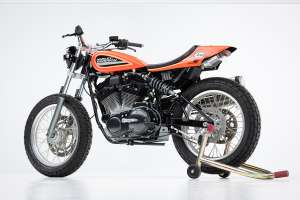

Richard ‘Mule’ Pollock has been in the business a long time, and if you’re a Bike EXIF regular, you’ve undoubtedly seen his work. Richard started out the way we all do, modifying his own bikes at home, but 1994 marked the start of his professional bike-building career when a friend asked him to modify a (then new) Harley Sportster. Emphasizing simplicity and function-derived form, Mule Motorcycles is undoubtedly one of the most prominent tracker builders in the United States, typically favoring Triumphs and Sportys.
For a guy like Richard, we’re certain repeat business is a common thing, but his latest project centers around a familiar motorcycle, instead of a repeat customer. It all started back in 2000, with Richard offering some helpful advice to a man named Ernie in Louisiana, who wanted to build his own Sportster-based street tracker.
“He wanted to know all the parts he should start gathering,” Richard says, “but he eventually realized the bike would always look like the first one he ever built if he continued. So, he concluded that he would have me build the bike.” Starting from scratch, Richard decided the best course of action would be to source a complete donor to supply an engine, title, front suspension and select brake and electronic parts, but what rolled into the shop wasn’t exactly a Sporty.

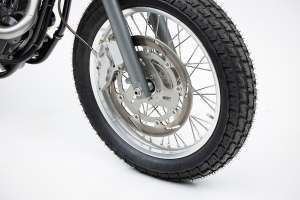
The bike Richard spec’d instead was a Buell M-2 Cyclone, which was discounted to just $5,600 at that time, putting it in the same ballpark as a standard Sportster. While the guts of the 1,203 cc, 45-degree V-twin were largely the same, Buell had pioneered their own Thunderstorm, big-valve heads, exhaust and other tweaks that boosted peak output to 94 hp and 83 lb.-ft. of torque—numbers that aren’t even in the same area code as the Sportster. With its heart, limbs and other major systems removed, the remainder of the Cyclone was sold off to help fund the coming work.

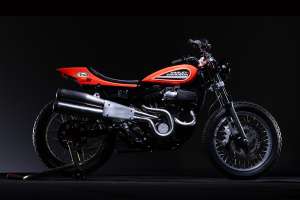
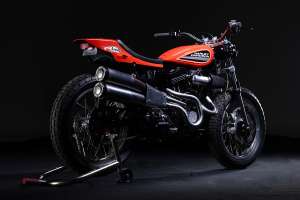
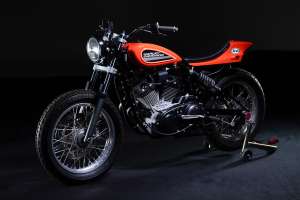
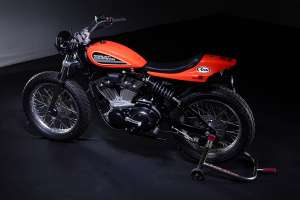
For the chassis, Richard went with a known quantity—a side-shock frame from C&J Racing Frames. “I had already built 30-plus bikes in this configuration, and the frame design required had evolved, so it would have a proper street bike geometry, as opposed to an XR750 race bike layout.” From there, the bike went together with Mule’s proven formula, boasting 19-inch aluminum wheels, the Cyclone’s front brake, bare-minimum lighting and a stunning set of SuperTrapp exhausts.

Richard relates that the bike was completed with a budget finish, looking a lot like what you’re seeing now, but with a solid-orange tank and the seat cowl in raw carbon fiber. “A guy who made custom carbon fiber guitars made me two molds to produce a bunch of tail sections,” Richard says. “I got the first four, and Ernie's bike got the second-to-last of them.”

The completed tracker was delivered to Ernie in Louisiana, but trust nearly cost him the entire motorcycle on an ill-fated joyride. “Ernie let a large relative take the bike for a ride,” Richard tells. “Upon traversing a railroad crossing, the 400-pound rider bottomed the suspension, smashing the carbon seat into the battery terminals. Carbon, being an electrical conductor, caused the seat to catch fire. The rider got the bike stopped and tore the burning seat off the bike with his bare hands. The bike was saved.”

While quick thinking and sheer nerve saved the motorcycle, a new seat cowl was required, and Richard sent Ernie the last of the remaining carbon tail sections from the guitar builder. “This was the last time I talked to Ernie,” Richard says. “Sometime a year or so later, I learned that Ernie had succumbed to injuries sustained while competing in a vintage motocross event.”
A niche like Mule’s is dominated by personal connections, and we’d wager Ernie’s tracker had slipped from collective memory with the news of his passing. I’m sure Richard didn’t expect to see it again until he received a phone call out of the blue, 20-plus years later, from Ernie’s son.

“Ernie's son contacted me with the news that he had secured the long-stored, missing bike from a relative,” Richard says. “He asked if I would be interested in going through it and getting it running again. As luck would have it, he was now living just 35 miles from me, stationed at Mountain Home Air Force Base. I had relocated to Boise from San Diego five years earlier, so the logistics became very simple.”

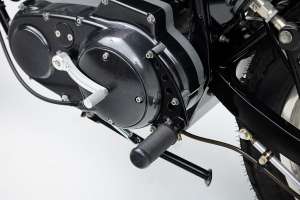
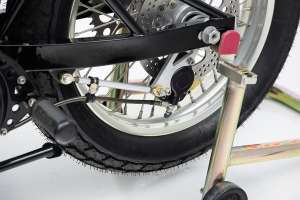
We’re all usually our own toughest critics, so what was it like going back through a bike you built 26 years ago? Richard relates that he was still happy with much of the detail work on the project, but some things needed to be upgraded based on an extra two-and-a-half decades of experience. Standard wear items like fork seals, brake hoses, cables and tires were replaced, while other pieces were upgraded. The rear Penske monoshock was rebuilt, standard braided steel lines were swapped for braided nylon and the engine covers received fresh powder coating.

Since Mule is a stickler for tabs and brackets, the mounts for the SuperTrapp exhaust were redone and the headlight got new billet mounts. Then, there was the heart of the matter—the seat cowl—which was repainted, with a new Shorai lithium battery underneath.
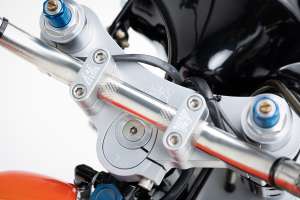
“A few items cleaned up well that are no longer available are the Ron Wood stainless handlebars, A&A triple clamps, rear hub and rear brake rotor,” Richard tells us. “I also added a Dynojet carb kit, new K&N air cleaner and my upgraded head breather kit. Special thanks to Meg Williams for her continued detail work and help getting this bike looking like it had just been built.”

Between the carbon-fiber inferno and Ernie’s passing, this Buell-powered street tracker has a few tough chapters in its story. Still, it’s hard to imagine a better outcome for this bike when things could have gone much differently. Instead of being sold out of the family, or tinkered on by some shadetree mechanic, the long-lost tracker landed in the hands of Ernie’s son, and the timing was perfect for it to return to the capable hands of Richard ‘Mule’ Pollock to make it like new again.
While the finished product is undoubtedly a Mule motorcycle, we’d wager this one will always be Ernie’s bike.
Mule Motorcycles | Website | Instagram | Photos by Bart Cepek


Comments
Interesting comments. From the top, on a build like this, as opposed to a stock Sportster, there's almost nowhere to stuff relays, fuses and wiring. A standard sized headlight shell gives a fair amount of real estate for switch, turn signal and headlight wiring. Harley's "Racer types" attempts have been a joke, unlike their actual race bikes. On shock placement...where would you suggest locating the shock on a side mount monoshock frame? Ducati lays them down onto the motor. I would love to do a project with HD, but they seem to be designing everything behind closed doors in a vacuum. Not sure where they get their input from. IMO, they should build a street model of their Championship competing XG flattracker and/or the Championship winning Super Hooligan roadracers. Both could help them get back into the world of relevant motorcycle manufacturing. The giant, heavy, tuna boat bikes have a following for sure, but hardly cutting edge. Just a little bit heavier, year after year. When I built my first Sportster motor'd streettracker in 1995, it appeared in Cycle World. I got 400+ phones calls in the first three weeks after it appeared. The calls continued from that one feature for 5-6 years. I've built at least 150 units like that, so yes, I think there's a lot of interest out there in an American made semi performance production motorcycle. I say "semi", because I don't think the current 150-200HP hyper bike power really fits the design parameters.
I agree with much of what you say. FWIW I like the headlight.
Hyper bike power is not in my realm . I just don’t get the mono shock .
Lovely build. I would personally go for a smaller headlight, but I see someone got a good idea already to black out the bezel.Well done.
They make them to sell. Can’t blame them . Several attempts at racer types didn’t sell
They did. More than once.
Good Looking BUT, I’m not crazy about that rear shock placement.
Agreed.
Richard nailed it !!!!
Why Harley never produced a bike like this given their heritage to flat track racing blows my fucking mind. No wonder they’re between a rock and a hard place right now.
Mule builds a beautiful bike Harley need your help dude.
Why Harley never produced a bike like this given their heritage to flat track racing blows my fucking mind. No wonder they’re between a rock and a hard place right now.
Mule builds a beautiful bike Harley need your help dude.
The level of skill and expertise on this bike is equal and in places better than many production bikes available from the major motorcycle manufacturers.
When someone says "motorcycle", Richard's builds immediately come to mind.
Makes you wonder why Harley morphed the original Sportsters into just another over weight cruiser.