



They say the brightest bulb burns half as long, and that analogy applies in more than one way to motorcycle board-track racing of the 1910s and ’20s. Banked wooden speedways popped up all over the U.S., made from simple 2x4s with 45-degree banked corners that enabled stripped-down machines to reach speeds of 120 mph. The racing was brutal, with flying chunks of wood, splinters and potholes adding fresh new terrors to a sport that had little regard for safety to begin with.
The racing surface would last up to three years if it was constructed well, less if it wasn’t, and by 1931, 80% of the board tracks had been shut down or abandoned in favor of pavement and dirt circuits. An unceremonious end for a novel form of motorsport, but the safety of racers and fans benefited. Still, the light from this Wild-West breed of racing has inspired countless builders, even now, nearly a century after the bulb burned out. Masumi Tsuchino is a standout among this group.

Tsuchino operates his own custom shop, INFINITY Inc., located in Iruma, Saitama Prefecture, just northwest of Tokyo. After a brief stint with Toyota, Tsuchino wanted to get back into motorcycles and took a job at Red Baron, a massive motorcycle dealer chain in Japan, before he moved on to the accomplished custom workshop Sure Shot in Chiba. Tsuchino made the ultimate leap to open his own shop in 2016.
Even before hanging his shingle, he harbored a deep fascination with the bare-bones 1920s American board tracker aesthetic. “I was drawn to its bicycle-like, ultra-narrow simplicity. I always thought if I ever had my own shop, I’d build one,” he says. Not long after opening INFINITY, a customer walked through the doors, granting him full creative freedom, and that long-held dream finally materialized into his first board tracker build.

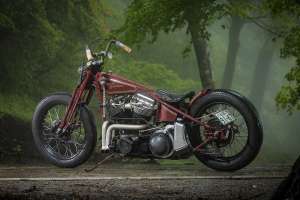
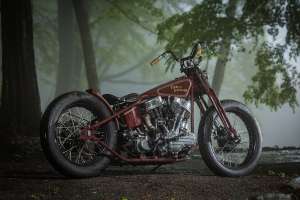
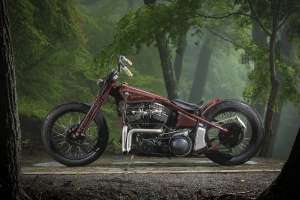
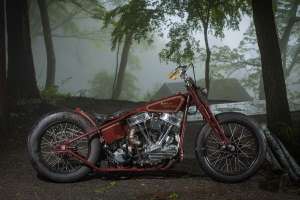
The machine you’re looking at is the immediate successor to that original project, aptly named BT2. Commissioned by a rider who wanted to capture the same vintage magic, the brief was straightforward but specific: build a board tracker, but base it around a classic Panhead.
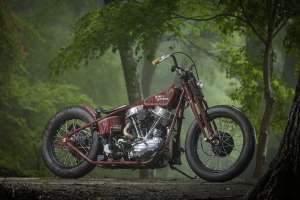
To set the baseline geometry, Tsuchino sourced a replica V-Twin wishbone frame and handed over a 1962 Harley-Davidson FLH 1200 engine to the vintage specialists at Tamamura Motors. The fully rebuilt 74-cubic-inch mill was then fortified with an Andrews-H cam, an S&S Super-E carburetor and a Dyna-S electronic ignition for a dose of modern reliability.

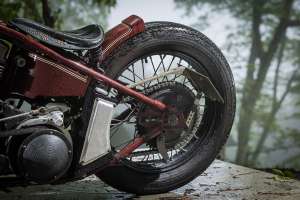
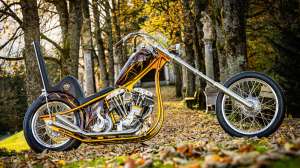
But dropping a vintage motor into a hardtail frame doesn't automatically make a board tracker. The illusion lives and dies in the stance. Tsuchino sourced a classic VL springer front end but refused to leave it stock. He painstakingly modified and narrowed the forks, pulling the front end in tight to mimic the razor-thin profile of early-century pacers. He matched that narrow geometry with a staggered wheelset, lacing a 19 x 2.25 rim to a VL star hub up front, and an 18 x 2.5 out back. Shod in vintage Allstate Safety Tread rubber and equipped with an S-Proud drum brake, the chassis looks like it could roll straight onto splintered wooden banking.

Board trackers are defined by their slim, slung-low gas tanks, but that minimalist aesthetic has real tradeoffs where the rubber meets the road. Tsuchino started with a hand-formed, impossibly slim tank that sweeps beautifully along the top tube. He scooped the underside, so it perfectly traces the profile of the Panhead’s iconic rocker boxes—a signature design cue of his BT series that ensures the engine visually dominates the bike. To keep the cockpit immaculate, Tsuchino incorporated a Motogadget Tiny speedometer with a brass ring that perfectly mirrors the opposing fuel cap.

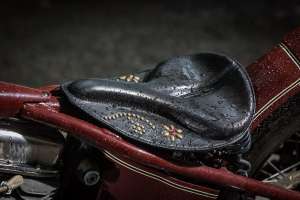
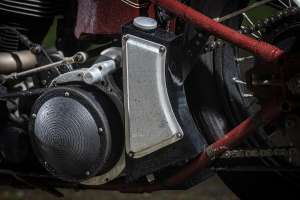
Next, a bit of crafty engineering was employed to solve the fuel capacity issue. Suspended beneath the Mesinger saddle is what looks to be a traditional oil bag. In reality, it’s a secondary fuel cell. An electromagnetic pump pirated from a Yamaha DragStar is tucked out of sight, quietly feeding gasoline from the sub-tank up to the S&S carb. The relocated oil tank is now a custom-fabricated, arc-shaped reservoir tucked covertly behind the BDL open primary, keeping the right side of the bike pristine.
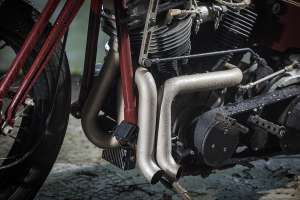
Tsuchino even routed the exhaust over to the left—a job easier said than done. The one-off pipes snake their way through the chassis, avoiding the kickstand, clutch and shifter linkages, before exiting forward of the primary drive. The way the pipe angles mirror the handshifter and linkage creates order, instead of clutter.

Despite its museum-quality vintage disguise, BT2 is built to be ridden in the real world, retaining a kickstarter, a modern electric start and an oil filter tucked within the belt drive. Tsuchino finished the build by parkerizing the custom one-off handlebars, footpegs, exhaust brackets and fork springs. The chemical treatment leaves a dull, charcoal-gray finish that grounds the bike in historical grit. The bodywork was then handed over to Rio Studio, who applied a deep, lustrous burgundy paint that provides the perfect contrast to the raw mechanical elements.

Tsuchino's mastery of this niche aesthetic is already paying massive dividends. His first iteration—a Shovelhead-powered tracker—dropped jaws at the 2019 Yokohama Hot Rod Custom Show, catching the discerning eye of legendary motorcycle photographer Michael Lichter, earning a prestigious award and landing dead center on the cover of VIBES magazine. With BT2, INFINITY has proven that the breakout success was no fluke. He isn't just mimicking history—he's refining it, hiding clever modern engineering inside a silhouette that looks fast enough to get you into serious trouble.

INFINITY Inc. | Facebook | Instagram | Images by, and with sincere thanks to, Kazuo Matsumoto
Comments