

In the early 1970s, the Triumph Trident T150 was a machine caught between two worlds. With its 741cc transverse triple producing 58 bhp and a top speed north of 115 mph, it had the heart of a champion. Yet, it struggled to maintain its footing against the "Superbike" onslaught from Japan. By 1972, Triumph was fighting back with five-speed gearboxes and conical hubs, but for those who truly wanted to go racing, the factory blueprints were merely a starting point.
Fast forward thirty years, and Davide Caforio of Ruote Fiere in Monza, Italy, found himself staring at a T150 that had been left to rot. It was a skeleton of a bike—incomplete, unloved, and stationary for three decades. When the owner presented Davide with two identical Tridents—one complete for restoration and one a basket case—the path was clear: one would return to the history books, while the other would be rebuilt as a tribute to 1970s English racing grit.

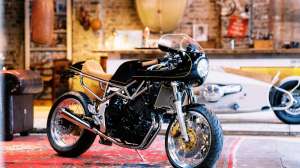
Davide’s vision for the chassis was a nod to the late Colin Seeley. Specifically, he wanted to capture the structural elegance of the Seeley-framed Boyer Triumphs of the mid-70s. This was no simple "cut and loop" job. Davide performed surgery on the stock frame, removing the massive factory downtube and replacing it with two smaller, lighter "V" tubes that dive into the lower cradles.
The modifications didn't stop at the tubes. For true sporting balance, Davide milled the engine crankcase attachment points to center the motor, which was notoriously off-axis in stock form. To bridge the gap from the steering head to the swingarm pivot, he added billet aluminum side plates and twin longitudinal tubes, mimicking the rigidity and purposeful stance of a Seeley racer.

The 750cc triple was cracked open and treated to a full 'speed-shop' overhaul. Davide lightened the crankshaft and reworked the heads with larger ports, but kept the displacement at 750cc to maintain a punchy low-end. For the internals, he went to the source: Peckett & McNabb (P&M). The historic English workshop supplied the racing camshafts and a dry-drive toothed belt kit to replace the heavy, stock oil-bath primary.
To keep the aesthetic period-correct, the Amal carburetors remain, though they’ve been bored out for better breathing. Hidden from view is a modern Boyer electronic ignition, ensuring that this vintage triple starts with Italian passion rather than English temperament.

The exhaust is a 3-into-1 system, ceramic-coated in matte black for thermal efficiency and a compact, aggressive profile. Perhaps the most ingenious bit of engineering is the gear shift; the original right-hand shift—notoriously clumsy for modern riders—has been converted to a left-hand setup through a clever arrangement of rods, joints, and links.
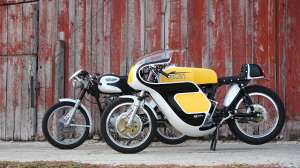
Given the workshop's proximity to the legendary Monza circuit—the 'Temple of Speed'—every detail of the Trident had to meet a world-class standard of performance and aesthetics. Davide began by overhauling the front end with a period-correct Ceriani GP35 fork set and matching triple clamps, paired with a pneumatic steering lock. The braking system is a work of art, featuring an aluminum racing drum kit with double-leading shoes, both front and rear. This setup provides powerful, modular stopping power that surpasses the original 1972 conical hubs while maintaining the vintage racing silhouette.

The bike's rolling gear consists of 18-inch Borrani rims—2.15 wide at the front and 3.00 at the rear—laced with stainless steel spokes and shod in period-appropriate rubber. The bodywork further leans into the English racing heritage; the stock Trident fuel tank was heavily modified and scalloped to make room for the low-slung racing clip-on handlebars. Behind it sits a handcrafted aluminum seat shell upholstered in leather, echoing the iconic Norton Manx aesthetic. The cockpit is a study in minimalism; there is no speedometer to be found. Instead, the rider’s attention is focused solely on a solitary Pitsch Krober electronic tachometer, tucked neatly behind a classic Manx-style front fairing.
The finishing touch is the aluminum oil tank, positioned centrally under the seat in the traditional English racing style, with a classic snap-on Monza cap peeking through the frame. It is a machine that looks like it just rolled out of the paddock at the 1975 English Tourist Trophy—raw, functional, and undeniably fast.

RUOTE FIERE | Website | Instagram | Facebook |
Photo Credit: ROSARIO LIBERTI
Comments