Triumph Rocket III Stellan Edition

Triumph Rocket III Stellan Edition by SE Service
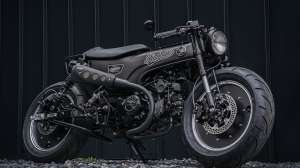
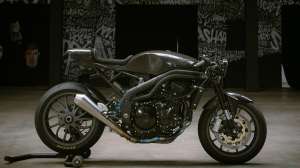
Swedish custom specialist Stellan Egeland is best known for his wild ground-up customs such as the SE Service Harrier. But he’s also made inroads into the mainstream market, thanks to an unusual alliance with Triumph Scandinavia. Triumph commissioned SE Service to work a little magic on the mighty Rocket III, and the result was the Stellan Edition. Egeland made three of these mean-looking sleds—two green and one black—and they were sold for around 300,000 Kronor (US$40,000) each. The price included a new fuel tank, new exhaust system and lowered instruments. The bikes were de-chromed, and naked filters replaced the air box. The rear frame was shortened, and a new front fender fitted. It gave the 2.3-liter, 140 bhp Rocket even more road presence, while Triumph got a bump in the street cred stakes and SE Service popped up on the radar of more Scandinavian bikers. So, kudos to Triumph for commissioning these bikes. Wouldn’t it be great to see Harley commission similar special editions from Mule or Storz? Or see Yamaha hooking up with Deus for a custom SR500? [Head over to YouTube to see the Stellan Edition on video.]

BSA Lightning custom

1966 BSA A65 Lightning custom motorcycle
I get to see a lot of bikes while researching posts for Bike EXIF. But it’s only occasionally that one will stop me in my tracks, and send me straight to eBay looking for an identical model. Kevin Giffin’s ‘Buster’, a 1966 BSA A65 Lightning, is one of those rare bikes. (It’s also a familiar model for me; in the 80s, there was a TV detective show in the UK called Boon, and a BSA Lightning featured in every episode.) Giffin’s BSA was an eBay find, but also a salutary lesson in buying unseen. “It was supposed to be a 1966 Lightning. It turned out to be a ‘bitsa’, and a well-worn one at that,” says Giffin. “After taking it apart, it became obvious that a complete rebuild was in order.” In the end, it took Giffin two years and over $10,000 to turn this bike into the stunning machine pictured above. He thoroughly reworked the 650cc parallel twin engine, giving it a 10.5:1 compression, a QPD primary belt drive, and a Boyer Bransden ignition. The bottom end and crank are from an A50, while the top end is from an A65. Giffen also installed Amal Monoblocs with open velocity stacks, and a late-model swingarm with bronze bushings. The front end is from a 1998 Honda CBR600F3—with clip-ons mounted above the triples—and both wheels are 18″ alloy rims laced with stainless steel spokes. Giffin did the paint himself, and says, “I went with the earlier tank style because I think the badges fit my look better. As with all customs, Buster has given me plenty of headaches along the way. But as you can see, it was worth it. He gets all the looks wherever I go, and handles like a sportbike at any speed and any angle.” Wouldn’t you love to have this machine in your garage? [Thanks to Peter Quigley for the tip.]

Canon EOS Digital Rebel XT | 1/1250s | f/5.6 | ISO 800 | Focal length 60mm

PS: Get the latest from Bike EXIF via twitter and our Facebook page.

Moto Gima

Moto Gima with AMC 125cc motor
There’s an intriguing story behind this super-stylish motocyclette. Despite appearances, it’s not a vintage machine: it’s an accurate recreation of a 1950s GIMA, and costs just €4,290 (US$6,000). GIMA was a short-lived French manufacturer that made small but stylish bikes from 1947 to 1956, and would have slipped into obscurity were it not for a businessman called Hilario Gonzalez. After working for engine maker AMC and then starting his own business, Gonzalez restored a GIMA for his son a few years ago. Bitten by the bug, he decided to remanufacture a 125cc GIMA using the original design, subtly updated with modern engineering—including electronic ignition and contemporary carburetion. Permissions were obtained from Paul Josué, the original frame designer, and from Gilbert Chartoire, the son of AMC’s founder. Gonzalez revealed the prototype to the public in 2005, and by early 2009 small-scale production was underway. Since then, production has been steady and demand strong. But the financial crisis has virtually crippled GIMA’s parent company—Gonzalez’ general engineering business—and it threatens to drag down GIMA too. We hope it survives: if you do too, there’s an online petition you can sign that requests support from the French government. [Spotted on Rollin' Free.]

Gas Gas EC 450 Desert

Gas Gas EC 450 Desert enduro motorcycle
A new enduro model from Spanish manufacturer Gas Gas is attracting interest, with a curious absence of information fanning the flames of curiosity. Details are remarkably scarce on this striking-looking machine; after a brief appearance on Gas Gas’ US website, was it was quietly removed. From piecing together information from sources scattered around the interwebs, it looks like the ‘EC 450 Desert’ is a limited edition bike built to special order. According to US dealer Lynburg Choppers, it’s scheduled to be available in the States in Feb 2010 at a cost of $10,499 plus tax. I suspect that the odd Dakar-style fairing plays a part in all this: there’s a touch of the Windjammer look in there, but to my eyes it’s aesthetically far more successful than any of Craig Vetter’s oddball creations. The specs are good high-end enduro stuff, with a lofty seat height of 940 mm (37 inches) countered by a very low weight of 133 kg (293 lbs). So it won’t be too hard to control with a few degrees of lean at a stop light. The engine is a four-valve, four stroke thumper—no word on power output—driving through a six-speed ‘box. If you’re planning a trip through the desert, this machine looks like a good bet—assuming you can lay your hands on one. [See the full 2010 Gas Gas range on Bike Tech.]

Honda CB550 cafe racer

1976 Honda CB550F Super Sport cafe racer
While browsing the addictive SOHC Forum, I stumbled across some images of this beautiful Honda CB550F Super Sport café racer. It’s owned by Larry Pearson, who was happy to provide a little background. “I picked this bike up as a rolling chassis from a very talented machinist, who was turning it into a vintage road racer,” says Larry. “It sat unfinished and perfectly stored for 12 years before I got it. He had already made many one-off aluminum pieces like the rear sets, the points cover, fork brace, clip ons, rear brake holder, muffler mount, and redesigned left-side engine covers. Other than the pipe and the modified air box, the engine is stock, with only 23,000 miles on it, and runs beautifully. It’s a total loss system—no starter/alternator—and will run on battery power for about six hours before a re-charge.” Larry hand-made the tail section out of fiberglass before frenching the taillight into it; he also made the seat, and another machinist friend helped with the fairing and gauge mounts. “The sub-fender is a front fender from a Yamaha, widened one inch and turned around,” he reveals. “The bike has a period-correct Kerker exhaust, shaved rear footpegs, and Boge Mulholland rear shocks laid forward two inches. I finished it by painting it black and cream two-tone, with a gold pinstripe separating the two colors.” It’s no trailer queen, though: Larry will take his CB550F out for a blast on a sunny day through the twisties, and “it handles, runs, and sounds great”. The bike came second in its class at the 2008 Legend of the Motorcycle Concours d’Elegance, and leaves me wondering what came first. [Larry has a custom and restoration motorcycle painting business. Contact him via email.]

1930 Indian Four

1930 Indian Four
This beautiful vintage Indian is owned by Buzz Kanter, publisher of the Harley magazine American Iron. During the hard times of the Great Depression and the war years, the Four was a luxurious anomaly. But Indian stuck with it, and today it’s a machine highly prized by collectors. Even more surprising is the purposeful, single-minded styling: it still has massive appeal seventy years later, and belies the remarkably convoluted history of the Four. It first appeared as the Indian Ace, after Indian bought the Ace Motor Corporation in 1927. The Ace was heavily modified to become the Indian 401, which then became the 402 after adopting the frame from the Indian Scout. Many drivetrain modifications followed—some disastrous—but the mighty 77-ci Four soldiered on until 1942. Today, there’s a thriving Indian Four club scene and you’ll need US$50-60,000 to buy a Four on the open market. If I had that kind of money to spend on a vintage motorcycle, this would be at the top of my shopping list. [Via Classic American Iron, spotted by Glenn Edley of stylish auto blog car137.]

Canon EOS 40D | 1/250s | f/13 | ISO 400 | Focal length 28mm

PS: Get the latest from Bike EXIF via twitter and our Facebook page.

TPR Urban Scrambler

Triumph-based Urban Scrambler by TPR Italian Factory
This delightful Triumph-based custom is the first model from TPR, a new Italian shop based in Milan. The aim of TPR’s founder Pietro Figini is to produce motorcycles with “character and charm”, using Triumph’s 865 cc engine and the Bonneville’s tubular steel cradle frame as a starting point. The specs look good: the parallel twin motor has been reworked to boost power from 67 to (a claimed) 75 bhp, and around 20 kg has been shaved from the stock Bonneville’s weight. The styling and detailing are absolutely top drawer, as the images on TPR’s website show. Best of all, it looks like the Urban Scrambler will not be a one-off: the company’s full name is “TPR Italian Factory”, no doubt to reinforce its production abilities. Several Urban Scramblers have already been built, with an ‘R’ variant in the pipeline and three other models on the drawing board. Looks like our favorite European Triumph specialists Mecatwin and LSL now have some competition. [Spotted on Pipeburn.]

BMW K1

BMW K1 motorcycle
When I hit my twenties, the BMW K1 was impossibly glamorous. It was the poster bike for motorcycling. As a casual observer, I didn’t realise it was BMW’s attempt to appeal to younger riders, seduced by Japanese sportsbikes such as the Suzuki GSX-R1100. And I didn’t know that BMW’s engineering and quality control—for once—was deeply flawed. To me, the K1 was the kind of motorcycle Luke Skywalker would ride if he existed in real life: a blend of warp speed power and futuristic styling. It was a machine straight from the pages of JG Ballard’s Vermillion Sands: glossy, lurid and bizarre, a vehicle for the wealthy and disaffected. (For what little it’s worth, it was also the world’s first production motorcycle with a three-way catalytic converter.) The 987 cc, 100 bhp K1 sold less than 7,000 units between 1988 and 1993, and its dynamics were trumped by machines such as the Honda CBR600F. But it’s still beautiful two decades later. And it broke the mould in the realms of styling and marketing, catching the eye of people who would never have otherwise looked at a motorcycle. I’d still choose one today over any 1990s Japanese or American bike—and not just because it’s the only motorcycle you can ride while wearing a scarlet leather one-piece.

PS: Get the latest from Bike EXIF via twitter and our Facebook page.

Bimota HB4

Bimota HB4 Moto2 racing motorcycle
It’s very rare that we feature a factory-fresh machine, but Bimota’s HB4 is a worthy exception. This compact, sharply-styled racebike is Bimota’s first Honda-powered bike since the CB1100-engined HB3 of the mid-80s. The boutique Rimini-based manufacturer has stuck with its signature trellis frame, but this time it’s a steel and magnesium hybrid, and it’s cradling a CBR600RR motor. Designed for the Moto2 series, the HB4 is claimed to weigh just 297lbs—a staggering 113lbs less than the quoted wet weight of Honda’s 2010-spec CBR600RR. Interestingly, several websites are reporting that a road-going variant of the HB4 will be produced if the bike is successful on the track, but a Bimota spokesperson told us, “We are thinking about a road version but we do not have a project or a prototype. We are just considering that idea”. We hope it happens, because a light middleweight sportsbike with Bimota’s pedigree and Honda’s reliability (at an affordable price) would be very tempting indeed. [See a video of the Bimota HB4 in testing on YouTube.]

Nikon D2Xs | 1/4s | f/10.0 | ISO 100 | Focal length 95mm

Get Adobe Flash playerPlugin by wpburn.com wordpress themes