

In the world of custom motorcycles, there is a distinct difference between those who build for the gallery and those who build because they simply cannot help themselves. For Kyle Pereira and Suraj Thapa of Mumbai-based Garage Built Motorcycles, the latter is the only reality they know.
Kyle’s education in internal combustion began at age ten, perched atop his father’s Jawa 250 with feet that couldn’t touch the tarmac. By the time he was lugging a basket-case Matchless G3L home in five burlap sacks, he had met Suraj, a master of British iron who had been wrenching professionally for decades. Together, they formed a partnership in 2012 that transformed from a private obsession into a specialized workshop. Their latest creation, aptly named ‘Fast Forward,’ is a study in what happens when you apply Indian ingenuity to a war-torn British relic.

The Triumph 3HW is a machine forged in the fires of necessity. Produced between 1941 and 1945 after Triumph’s Coventry factory was leveled by the Luftwaffe, the 3HW was the backbone of the Allied riders. It was a 343cc overhead-valve single, essentially a militarized Tiger 80. To save precious aluminum for the RAF, Triumph cast the rocker boxes and primary covers in heavy iron.
The 3HW was reliable, rigid, and, by Kyle’s admission, a bit of a "sturdy gentleman" at 145 kg. Kyle’s donor was a post-war survivor that had been ravaged by a house fire, leaving the engine block warped and the frame a Frankenstein’s monster of Triumph and Royal Enfield parts. Most would have seen a scrap heap; Kyle and Suraj saw a drag racer from a parallel timeline.

The concept for Fast Forward was organic. Kyle describes it as a vintage custom drag bike that attempted to time-travel into the future but got snagged halfway through the portal. The goal was to retain the classic British mechanical soul while injecting Japanese custom styling and American hot-rod grit.
The heart of the build is a masterpiece of ‘in-house’ problem-solving. Because the original cast-iron cylinder block was warped beyond repair, the duo decided to cast a new aluminum block. The result is a unit that is 2.5 kg lighter than stock and dissipates heat far more efficiently. Inside, they fitted a New Old Stock (NOS) Triumph T80 slipper racing piston from the 1930s, bumping the compression from a lethargic 6.7:1 to a peppier 7.5:1. With lightened rocker arms and a blueprinted head, the old warhorse now gallops with roughly 20 hp.

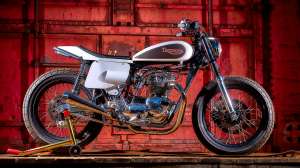
Visually, the 3HW’s wartime bulk has been replaced by sharp, aggressive lines. The stock WD-spec fuel tank was notoriously bulbous, overshadowing the small engine. Kyle, who had never formed sheet metal before, picked up a hammer and a couple of dolly blocks and set to work. He fabricated a split-tank setup: the left side holds fuel, while the right side acts as an oil reservoir.
Moving the oil from its traditional tank under the seat to the front of the bike created a massive amount of negative space at the rear of the frame, a hallmark of the drag-bike aesthetic. To cap off the front end, Kyle repurposed an old helmet to create a sleek bikini fairing and flyscreen, a brilliant bit of upcycling that perfectly houses the modified triple clamps.

The original girder forks were swapped for a modern telescopic front end from a Yamaha FZ16. It’s a polarizing choice for purists, but one that provides the stability and disc-brake stopping power required for a bike designed to be ridden hard. The rear remains a rigid affair, but the silhouette is transformed by a hand-made racing hump that hugs the rear wheel, replacing the original sprung solo saddle.
The primary drive has been stripped open, exposing the chain and giving the bike a raw, mechanical urgency. A custom-made air filter and a hand-bent exhaust pipe ensure the 343cc single sounds as aggressive as it looks.

Finished in a deep racing green with sharp yellow highlights, Fast Forward has shed 20 kg of wartime weight, tipping the scales at a lithe 125 kg. It lacks a speedometer, a headlight, and any sense of practicality, but it possesses an abundance of character.
"Not a single drawing or render was created," Kyle says. "The lack of a drawing helped by creating absolutely no restriction on the direction and flow of the build." It is a testament to the fact that sometimes, the best way to move a vintage machine forward is simply to stop overthinking and start hammering.
What are your thoughts? Let us know in the comments below.



Comments