Yamaha V Star 650

2001 Yamaha V Star 650 Classic custom motorcycle
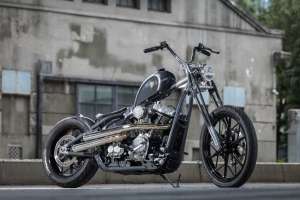
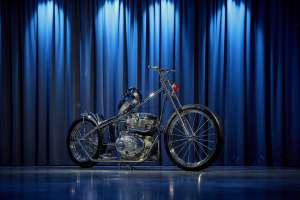
What do you do if you’re saddled with a small metric cruiser you don’t particularly want? Sky Fleming, a reader from Utah, found himself in this situation recently. He got a Yamaha V Star 650 in trade for an ATV, and instantly developed a dislike for his new acquisition. “I ripped into the bike that night. It lost about 60 pounds of chrome,” he says. Sky cut the shiny covers off the aftermarket pipes, revealing the (much cooler) raw steel underneath. He dismantled the front end, repainted it, and moved the forks up in the trees to lower it. Then he relocated the rear shock mount to drop the back end too. The sides of the tank were dished using ball peen hammers, smooth enough to to be repainted without filler. It’s now matt black with almond in the dished section, plus subtle gold leaf to add highlight details. A friend hammered the seat out of aluminium, and Sky himself beat a salvage yard fender until it fit snugly with the back tire. The result is slick, but the transformation of this V Star was quick: “Me and my friend have about 30 hours each in it,” Sky reckons, “minus the paint dry time.” Just goes to show what you can do with the humblest of raw materials. [More on the current V Star 650 on the Star Motorcycles site.]

Alma Four

Indian Four custom motorcycle
It looks like an Indian Four and it rides like an Indian Four, but this motorcycle has never been anywhere near Springfield, Massachusetts. Sitting in the frame is a one-liter NSU car engine, mated to a four-speed gearbox and shaft drive from a European pre-war motorcycle. The frame is a one-off, built to accommodate the tall SOHC engine; on a genuine Indian Four frame, there’s an additional straight tube running under the gas tanks. But the look is just right, helped by a vintage 1920s headlight and a repro Indian front end and fenders. The detailing elsewhere is lovely: the tanks, flywheel housing and engine sump are beautifully cast in aluminum. The forms for these were made by owner/builder Bartholin, who spent literally hundreds of hours on those three parts alone.

Bartholin is an industrial designer and this project took him eight years—rather than the two he anticipated—partly because he was perennially broke, and partly because he got married and had kids along the way. The Alma Four apparently handles well, given that it’s based on a vintage American behemoth. And thanks to the air-cooled NSU Prinz engine, reliability is not an issue. (The motor was also used in the Münch Mammut, by the way.) Purists may scoff, but there’s something oddly appealing about this motorcycle. It’s a mix of vintage and modern componentry put together with great skill and a sensitive eye. And there’s something to be said for a bike of any description that starts first time in the morning. [With thanks to Kim Scholer.]

PS: Get the latest from Bike EXIF via twitter and our Facebook page.

Yamaha YZR500 OW35K

1978 Yamaha YZR500 racing motorcycle
By guest writer Richard Fowler of Motorsport Retro. When a young Kenny Roberts first ventured to Europe in 1978 to ride in the 500cc World Championship, no one was expecting him to be a title contender. But he was armed with the brutal Yamaha YZR500 OW35K, and created history by winning the 500 cc crown at his first attempt. He became the first American to take the title, despite having never ridden the European circuits before.

Part of this is obviously due to his machinery. The original OW35 appeared in 1977; it was Yamaha’s first new 500cc factory racer since the OW23 of 1975, which Giacomo Agostini rode to World Championship glory. For Roberts’ title attack in 1978 the factory chose to evolve the OW35, chiefly by adding an aluminum swingarm and the ‘Yamaha Power Valve System’. (By running an oval shaped valve, the YPVS altered the size of the exhaust port at different revs—effectively changing the power delivery and producing optimal power and torque across the entire rev range.)

Even in Roberts’ hands, and despite the YPVS, this Yamaha was a handful. The two stroke, water-cooled inline four punched out an arm-snapping 120hp, and revved like a bastard all the way up to 10,500rpm. And despite weighing a mere 135 kg, it still needed two front discs to slow it down from a 290kph+ top speed.

The 1978 title fight went down to the wire in the end, with Roberts’ third place at the Nürburgring finale proving enough to beat Pommy superstar Barry Sheene to the title by ten points. The rest is history: Roberts famously won the Championship again in 1979 and 1980, giving him three consecutive 500cc World Championships to his name.

BMW R100/7 scrambler

BMW R100/7 scrambler with Supertrapp muffler
Even the stateliest grand tourer can be turned into a scrambler. This example is a 1977 BMW R100/7 owned by Frank, from Kandel in Germany. He bought the bike in 1983, with just 5,000km on the clock; the BMW is now up to 196,000 km, without any issues apart from a gearbox defect last year. Frank lowered the forks 6 cm, and made a new sub-frame, seat and license plate bracket. He also fitted Tomaselli bars, Koso digital instruments, Dunlop Trailmax tires, a Ducati rear fender, and a fuel-tank from a BMW /5. The muffler is a Supertrapp and it sounds unbelievable: check out this YouTube video to hear it for yourself (at 1:02 in).

PS: Get the latest from Bike EXIF via twitter and our Facebook page.

Rob North Triumph Trident

1974 Triumph Trident race bike with Rob North frame
Rob North is a name you occasionally hear in classic racing circles, but it seems that few people know much about the man. In the 1960s and 70s he built frames for BSA and Triumph triples, working with factory bikes, and at least one Honda CB750. North’s reputation was high, and the rights to the name and frame designs were sold first to Miles Engineering, and then a company called Trident. Today, Trident is a small outfit in the West Midlands of the UK that manufactures the Rob North Trident road bike and a BSA Rocket racer. (The word is that Rob North himself now lives in California.) The bike in the picture is a 1975 machine that was freshened up by the French restoration specialist Kerlo Classic. They’re a highly-regarded company with an enviable portfolio of work (and a client list that includes Philippe Starck). If you have a minute to spare, it’s worth checking out Kerlo’s other beautiful road racing restorations. And if you know what Rob North’s up to these days, drop us a line in the comments. [Spotted on Ze Last Chance Garage. Photo by Bruno Des Gayets.]

Opel Motoclub

Opel Motoclub motorcycle
While browsing the addictive LoudPop Voyager I stumbled across a bike I hadn’t seen before. It was an Opel Motoclub, an unusual 500c thumper from between the Wars. This machine was one of the highlights of the 1928 Berlin Automobil und Motorrad show: designed by Ernst Neumann-Neander, one of the pioneers of pressed-steel construction, it looked like no other motorcycle on the market. The metalwork was cadmium plated, and most of the leather and rubber was red—right down to the tires. Even more strangely, Fritz von Opel built a rocket-powered version too. According to The Vintagent, “The rider activated the rockets with a foot pedal, after using the motorcycle’s engine to reach 75mph; Opel calculated that 220km/h (132mph) was then possible”. Opel’s plan to break the world land speed record was unfortunately thwarted by the German authorities, but the more sedate, regular Motoclub lives on. If you’re tempted, there’s a lovely 1928 model for sale at the Dutch dealer Yesterdays for €24,500—around US$33,000. [Image via German website Motor-Talk.de.]

CB750 Cafe Type Motorimoda

Honda CB750 custom motorcycle by Whitehouse and Motorimodo
One of the most consistent Japanese custom motorcycle builders is Whitehouse, famous for meticulous replicas of classic Japanese racebikes and recreations of the Mad Max “Kwaka” KZ1000. But Whitehouse’s main business is modern updates to the iconic CB750. For this latest model, the company has hooked up with hip Ginza retailer Motorimoda. The gorgeous CB750 Cafe Type Motorimoda is hand-crafted from aluminum and carbon fiber, and costs a surprisingly reasonable ¥ 2,500,000 (US$29,000). It’s not all show and no go, either: the engine has been reworked to boost power by 20bhp, giving it a healthy 90bhp or so. [Check this video to hear it in action.] If this doesn’t wet your whistle, Whitehouse has plenty more tempting CB750s on a standalone showcase website. Be warned though: once you’re there, it’s hard to leave.

PS: Get the latest from Bike EXIF via our Facebook page.

BMW R100/7

BMW R100/7
Most of the machines we feature on Bike EXIF are one-offs, or limited editions, or customized in some way. But if I was planning a long, leisurely trip cross-country, I’d be looking for a classy, relaxed tourer. And with a pair of authentic Krauser panniers installed, this immaculately preserved BMW airhead would fit the bill perfectly. As Big Bike said in its 1977 review, “No slouch in the tight stuff, the R100/7 still loves to soar across the roadways of the world like a high wind over the sea. Still the ne-plus-ultra of touring bikes.” During its four-year production run—from 1976 to 1980—the BMW R100/7 was probably the most desirable bike in the world. Just 12,000 rolled off the production line, and they were regarded as the Rolls Royce of motorcycling. This pristine example is owned by Neil Rote, a vintage guitar and amplifier dealer who lives in a small town in rural Australia, some 250km from Melbourne. Neil has great taste in bikes as well as Gibsons and Fenders: his garage also includes a 1970 Norton 750 Commando Fastback (with Dunstall upgrades), a 1973 Laverda 750 SF1, a 1983 Moto Guzzi 1000SP and a 1960 BMW R60 sidecar rig. All these motorcycles are things of beauty, and you can pore over them on the Grouse Guitars website.

Olympus SP500UZ | 1/640s | f/3.3 | ISO 80 | Focal length 16.6mm

Honda CB450 cafe racer

Honda cafe racer
Honda’s CB450 never quite met its sales expectations, despite being one of the few 1960s motorcycles to hit the magic 100bhp/liter mark. Honda claimed it was a 450 with the power of a 650—and yes, it was a technological step forward from the British twins of the time. Buyers got greater reliability, an electric starter and more advanced engineering inside the DOHC parallel twin, which included unusual torsion valve springs. This elegant CB450 is a 1969 model that was rebuilt as a cafe racer by Shaun Stewart of Slingshot Cycles, [oops, the website has now crashed] a Virginia-based outfit that specializes in manufacturing brake hoses for classic motorcycles. The rear seat is actually part of a Yamaha XS650 fuel tank, while the front end is a hybrid mix of CB550/CB750F components strengthened by a homemade fork brace. The stainless steel exhaust system is also homemade, and the headlight bucket has a built in tachometer. Shaun likes to customize a couple of bikes a year as a sideline, and he’s done a great job with his cafe racer: it’s the perfect machine for blasting around the Appalachian mountains and Shenandoah Valley.

PS: Get the latest from Bike EXIF via twitter and our Facebook page.

Get Adobe Flash playerPlugin by wpburn.com wordpress themes