

In the world of custom motorcycles, we are often seduced by the gravitational pull of the big shows. Events like The One Moto, Handbuilt, or the Bike Shed shows dominate our feeds with high-production value and museum-quality lighting. But while those shows represent the pinnacle of the craft, the real lifeblood of the culture flows through grassroots local events. It is in these smaller, rain-slicked parking lots and VFW halls that the next Winston Yeh or Maxwell Hazan is often cutting their teeth on a first build, far away from the polished pedestals of the mainstream.
I recently found myself in Haverhill, Massachusetts, for the 5th Edition of the La Espada Chopper Show. Put on by the La Espada Chopper Club, an East Coast outfit that prioritizes riding and fabrication over social media clout, the show was a reminder of what makes this scene tick. Held at the local Veterans of Foreign Wars (VFW) hall, the event featured a curated invited builder section, raffles, and a raw energy that no corporate-sponsored event can replicate.

Attendance might have been hampered by the kind of cooler temperatures and intermittent rain that define a New England spring, but the hearty souls who showed up were treated to something special. While Harley-Davidson Pan-Shovels seemed to be the weapon of choice for the locals, the show was a mix of Shovelheads, Sportsters, and a smattering of Triumphs and XS650s. These were no trailer queens; they were machines meant for the asphalt, evidenced by the occasional oil drip on the VFW floor. Here are 5 Custom Choppers from the La Espada Chopper Show.

1. Evelyn Mitchell’s Harley-Davidson Shovelhead Long Bike
Hailing from Danville, New Hampshire, Evelyn Mitchell, brought a Shovelhead that perfectly captures the tall and narrow chopper ethos. Built around a rigid aftermarket frame with a raked neck, the bike features a classic extended front end and a 21-inch spool front wheel wrapped in Shinko vintage-style rubber. It’s a bike that demands attention not through complexity, but through the perfect execution of a timeless silhouette.
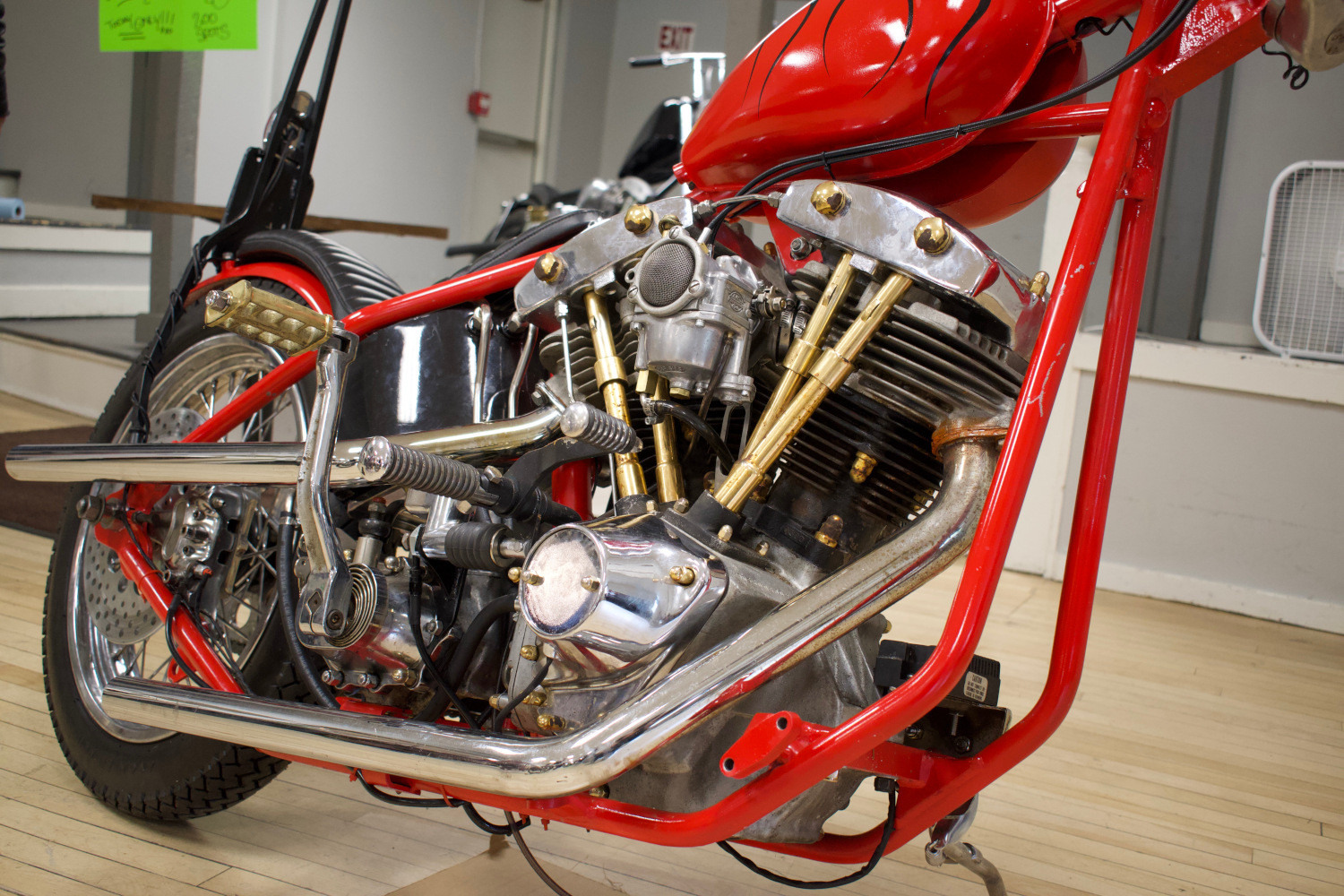
The motor is the star here, updated with brass-plated pushrod tubes and fasteners that provide a sophisticated pop against the cases. It’s mated to a Harley-Davidson Rotary Top four-speed transmission, and is operated via a hand-shift, foot-clutch setup. The open belt primary sits exposed, adding to the bike’s raw, mechanical charm.
The bodywork is quintessential chopper: a high-tunnel two-gallon peanut tank and a horseshoe oil tank. A trailer-style fender wraps tightly around the 19-inch rear wheel and its Avon MKII tire. A fire-engine red paint with black flames adorns the tank, fender, and frame. With low-rise Z-bars on tall risers and a pleated Cobra seat flowing over the rear, it’s a masterclass in the classic long bike.

2. Jimmy Kaldi’s Harley-Davidson Evo
At just 24 years old, Lowell-based tattoo artist Jimmy Kaldi decided to tackle a project that would make many veteran builders sweat. For his first custom build, Jimmy decided to shoehorn an 80-inch Evolution motor and five-speed transmission into a recently hardtailed Shovelhead frame. It’s a combination that is notoriously difficult due to the rear Evo rocker box clashing with the seat tube.
The solution was elegant in its simplicity. Kaldi took the frame to New England motorcycle builder Oxford Co. who notched the seat tube to allow the heads to fit. By doing so, he managed to retain the factory Harley-Davidson neck casting and, crucially, the factory numbers for titling purposes. The bike rolls on stock H-D mag wheels, with an extended front end controlled by stainless steel riserless bars that lend a subtle Club-style vibe to the chopper stance.

The metalwork is straightforward: a Frisco-mounted dished gas tank, horseshoe oil tank, and trailer fender, all finished in a muted, understated pink/lavender. The Cobra-style seat ties the aesthetic together, but the real talking point is the exhaust. Jimmy fabricated a custom 2-into-1 system that collects at the rear with a star-pattern tip, a quirky detail that reflects the builder’s creative background.

3. Derek Savage’s Patina Pan-Shovel
Derek Savage is a name that carries weight in New England, having built everything from People’s Champ contenders to gritty daily riders. For La Espada, he brought a Harley-Davidson Pan-Shovel housed in a Harley Panhead frame, a combination that exudes old-school muscle. It’s a bike that looks like it has lived a thousand lives, and every one of them was fast.

The front end uses a Wide Glide setup with a 19-inch wheel and a drum brake. Six-inch risers carry wide riser bars, and a vintage dual-headlight setup provides more cool factor than actual lumens. At the rear, a ribbed fender is supported by custom-fabricated struts, wrapping an 18-inch wheel equipped with a mechanical drum brake. It’s a build that values functional, proven parts.
The standout feature is the paint by Nathan Sykes. The Frisco-mounted Sportster tank, oil tank, and fender feature a black base with classic red, orange, and white flames. What makes it remarkable is the deliberate patina Sykes added, giving the finish a weathered, vintage feel that perfectly matches the aging chrome and the storied history of the Panhead frame.

4. The ‘Parking Lot’ Pan-Shovel
Sometimes, the best bikes aren't in the invited section. Found in the parking lot and ridden to the show by a member of the La Espada club, this Harley-Davidson Pan-Shovel is the quintessential East Coast chopper. Built around a rigid Panhead frame, it’s a machine that prioritizes the riding part of the club’s mission statement.
The bike forgoes the springer front end and uses a traditional telescoping Narrow Glide front end at stock length, rolling on a 21-inch front wheel and Avon MKII tire. The cockpit is ruthlessly clean, featuring stainless steel riserless T-bars and a total lack of handlebar controls. This is made possible by a foot-clutch and hand-shift setup connected to a Ratchet Top four-speed transmission.

The Frisco-mounted Sportster tank and fender are finished in a simple red-with-baby-blue flame job. It isn't complex or flashy, but it feels undeniably 'right', a perfect example of a bike that is loved, used, and built to survive the roads of Massachusetts.

5. Mike Ball’s ‘Green Dragon’ Triumph
Mike Ball’s 1970 Triumph Bonneville survivor, dubbed the ‘Green Dragon,’ is the epitome of the 1970s aesthetic with its molded frame and psychedelic paint. It is an acid trip on two wheels, and the molding throughout the frame and tank is a level of detail that needs to be seen in person to be fully appreciated.

The front end utilizes a 4-over-stock Springer fork, carrying an FNA headlight and a 19-inch spool front wheel. Steering is handled by a pair of re-chromed mini-ape hangers original to the 1970s build, fitted with an Amal throttle and custom acrylic grips. The various shades of green used in the molding give the bike an incredible depth, making it look as though it was pulled directly from a time capsule.
Despite the show-stopping finish, the bike is built to run. The Triumph twin has been updated with a Joe Hunt Magneto, allowing Mike to ditch the battery and the associated wiring clutter. Twin Amal carburetors with open velocity stacks ensure the bike breathes as well as it looks. It’s a kick-start-only machine that proves some things were done right the first time around.

As the rain continued outside the Haverhill VFW, the 5th Edition of the La Espada Chopper Show proved that the custom scene doesn't need stadium lights or high-gloss pedestals to thrive. It just needs a dedicated community, a bit of grit, and enough stainless steel to catch the dim light of a New England afternoon. These five bikes serve as a reminder that the most authentic builds are often found exactly where they are built to be: on the road.

Comments