

Two-strokes, transverse Vs, subtle reworks and complete reinventions, our list of the top five custom motorcycles of March has (literally) a bit of everything. While there are no trends to trace or commonalities of any sort between the following five bike builds, one thing is not up for debate—our readers absolutely loved them.
Each of these custom motorcycle builds could stand on its own merit, but collectively, they formed one of the best months in recent Bike EXIF history, and we’re floored. So join us, if you will, for a victory lap for last month’s most viral custom motorcycles.

1999 Harley-Davidson Softail by MF Customs
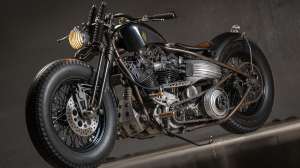
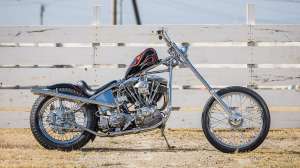
Hailing from MF Customs in Poland, the ‘Caddy’ started with a bizarrely perfect 1999 Harley-Davidson Softail donor. Before the bike was mothballed for twenty years, the previous owner swapped in a brand-new 80-cubic-inch Evolution engine and a fresh five-speed transmission. Maciek Fludziński essentially inherited a factory-fresh drivetrain, which allowed him to skip the mechanical triage and focus entirely on the high-end aesthetic transformation.
The stance was slammed using a Progressive Suspension kit up front and a lowering kit in the rear. It rolls on classic 60-spoke wheels—21” front and 16” rear—shod in vintage-style Shinko 270 Super Classic rubber. To give the crate-fresh Evo some teeth, Maciek added a Mikuni HSR42 carb, a high-flow air cleaner and custom-fabricated shorty pipes to “wake the entire neighborhood.”

For the bodywork, Maciek started with a Lowbrow Customs ribbed tank, flowing into a bespoke sissy bar and a towering king and queen seat to anchor the silhouette. The cockpit is equally lean, featuring custom stainless beach bars, TC Bros levers and a tiny speedometer to keep things in check.
The finish is a nod to 1950s GM luxury, pairing Cadillac Blue with deliberately patina’d metal accents. That diamond-stitched leather on the custom seat completes the Cadillac vibe while Performance Machine calipers provide modern bite. It’s a flawless piece of Polish craftsmanship that proves the American Dream can be reimagined anywhere—provided you’ve got the right eye for detail. [More]

1980 Moto Guzzi 850 T3 by 24 Bikes
After four decades in banking, Jochen Heinrich didn’t ease into retirement—he pivoted hard. Back to oil, metal and muscle memory from his youth in his father’s Honda dealership, he’s launched 24 Bikes with a simple premise: one build per year until he hits 80.
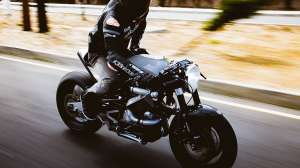
The donor is classic Guzzi—an 844 cc air-cooled transverse V-twin with pushrod-operated valves, a longitudinal crank and shaft final drive. In stock form, the T3’s linked braking system and touring geometry prioritized stability over urgency. Heinrich keeps the architecture intact but removes the excess—discarding factory bodywork, simplifying the subframe and tightening the overall package to shift the bike’s visual and dynamic center forward.

The engine has been gone through with intent. The top end is refreshed, breathing through Dell’Orto carburetors and a freer-flowing intake path, then exhaling through a hand-built titanium exhaust system that reduces weight and backpressure. The stock electrical systems have been modernized for reliability with a Motogadget mo.unit blue and an Elektronik-Sachse electronic ignition. The result is a cleaner-running big block with improved throttle pickup and reduced rotational drag.
Cycle parts bring it into line. The chassis is shortened and cleaned, finished with a pair of 18-inch Borrani high-shoulder rims. Suspension is updated to better manage the Guzzi’s shaft-drive squat characteristics while braking is modernized beyond the original linked setup for improved feel and modulation. It lands at around 200 kilos—lighter, stiffer and more responsive without compromising the inherent durability of the platform. [More]

Yamaha RD350LC by Patrick Lyall
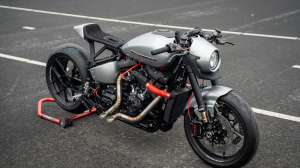
The Yamaha RD350LC has always been less about refinement and more about timing—ports, pipes and a powerband that rewards commitment. This build leans into that DNA, reworking the LC as a hybrid rather than a restoration. It keeps the compact aggression of the original but trades period limitations for modern chassis logic and sharper mechanical intent.
Builder Patrick Lyall started with a bare Yamaha LC frame, but the running gear is anything but stock. A Honda NC29 swingarm replaces the original unit to preserve the bike’s proportions, paired with Kawasaki ZX-6R forks up front. Aprilia RS125 wheels complete the package, with custom-machined components and rearsets tying it all together. The result is tighter geometry, improved rigidity and a chassis that corrects the LC’s vague twin-shock-era handling without stretching the wheelbase.

The engine follows the same hybrid logic. Sourced separately and rebuilt, the parallel twin is enlarged to 375 cc via resleeved and ported cylinders with fresh pistons to match. Induction comes from 32 mm Mikuni flatslide carburetors feeding a top end tuned for high-rpm efficiency, while Jim Lomas expansion chambers handle exhaust duties—prioritizing scavenging and peak output. It’s a classic two-stroke recipe but executed with modern precision and component quality.
Final numbers tell the story. In race trim, the engine pushes close to 80 horsepower, though it’s been dialed back to around 64 bhp for the road, trading peak output for midrange stability. It still revs to 13,000 rpm, and future plans include an upgraded ignition and a TZ-spec crankshaft. With a bespoke wiring loom, hydraulic clutch conversion and modernized braking, the result of Patrick’s build is an LC that punches above its original weight class, but with a chassis and control package that can actually use it. [More]

1975 Honda Super Cub by Brian Ricketts
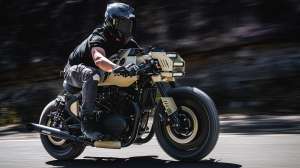
The Honda Super Cub was never meant to be fast. Pressed-steel chassis, horizontal engine, mass mobility baked into every decision. That construction is exactly what makes it difficult to modify—and exactly why builders keep trying. This 1975 C70 doesn’t just push past those limits, it deletes them entirely.
Builder Brian Ricketts keeps just enough of the Cub to anchor the silhouette—forks, headstock, tank and mudguard. Everything else is replaced. A new chassis is fabricated from cold-drawn seamless tube, TIG-welded on a homemade jig with a longer top tube and increased rake. The structure ties back into the original pressed-steel body but finishes in a hardtail rear, trading compliance for rigidity and stance.

The engine swap sets the tone. In place of the stock 72 cc four-stroke sits a 1975 Yamaha DT250MX single—air-cooled, five-speed, and good for roughly 24 horsepower. It’s a threefold increase in output, packaged into a frame that was never designed to carry it. Fitment is tight enough that installation is a one-way operation, with the cases forcing asymmetry into the bodywork. Induction and exhaust are purpose-built, including a custom expansion chamber system with a front exit to manage space and flow.
Cycle parts are brought up to match. The front end is widened and reworked with modified yokes, while Racing Boy rims are laced to Y125Z hubs and paired with oversized disc brakes. A custom lever system is added to counter front-end lift under braking. Out back, a matching setup with a rose-jointed torque arm and bespoke chain drive handles load transfer. The result keeps the Cub’s outline intact but completely rewrites its function—less commuter, more mechanical provocation. [More]

1973 Honda CB750 Café Racer by Minami Motorcycle
The Honda CB750 didn’t just set a benchmark in 1969—it scattered it. Inline four, overhead cam, front disc brake, electric start. It was engineering made accessible, and it reshaped the market almost overnight. This particular ’73 example adds another layer—it spent years abroad before being imported back to Japan, returning to the country that originally engineered it.
At Minami Motorcycle, the brief was restraint. Not a reinvention, not a parts catalog exercise—just a careful edit. The frame is trimmed where it typically gets awkward, with the rear loop cleaned up and excess mounts removed. Up front, the forks are dropped two inches to level the stance, paired with a minimalist CNC-machined top clamp that reduces visual clutter without altering the bike’s core geometry.

The 736 cc SOHC engine stays largely intact, and that’s the point. Original 28 mm Keihin carburetors and the factory intake system are retained, preserving the CB’s baseline fueling and response. Changes are peripheral but deliberate—a simplified exhaust system with a four-into-one header and reverse-cone silencer sharpens the note without chasing peak output. A full rewire introduces a Motogadget control unit, modern regulator and lithium battery, updating reliability without disturbing the engine’s character.
What lands is balanced rather than transformed. Original bodywork remains, down to the Candy Bacchus Olive tank and side covers, while refinished wheels and updated electrics sit just beneath the surface. It reads like a period café build executed with modern tolerances—less about outright performance gains, more about removing friction from the original design without erasing it. [More]

Comments